

“Death is not the worst of all evils.”
(General John Stark)
A few weeks ago, a poll result began circulating on X: Americans now appear to be more hostile to the construction of data centers than to the construction of nuclear power plants. This is striking because for decades, the nuclear reactor has been the archetypal object of anti-abundance politics.
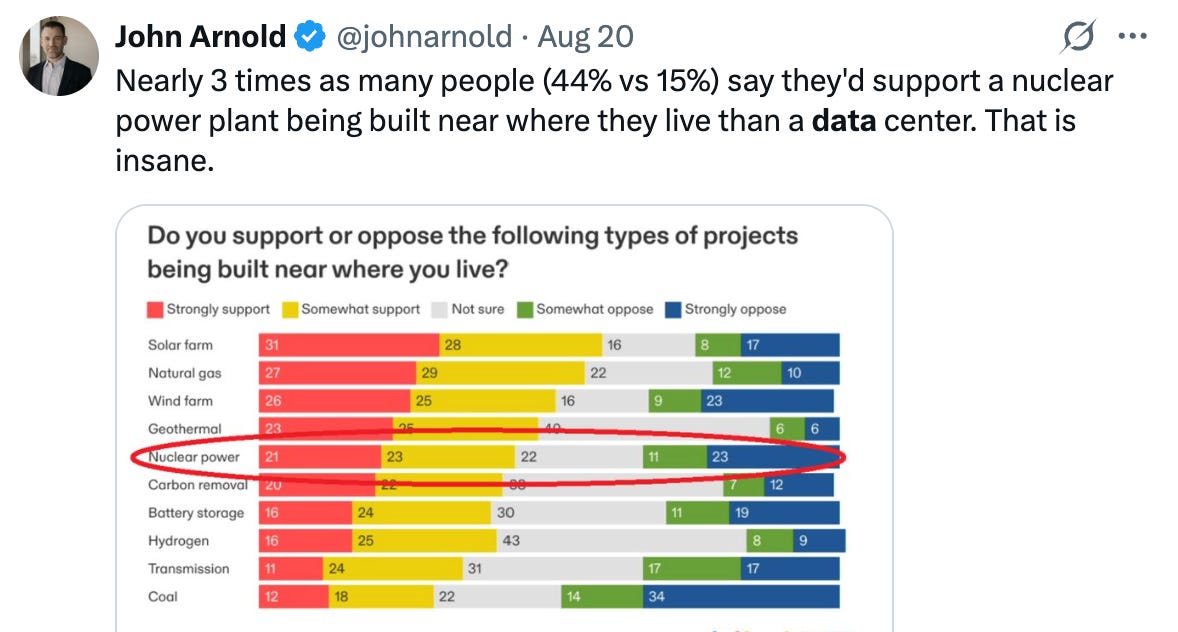
Looking at how nuclear power plants have become so hated is instructive. On many objective grounds, they are perfectly fine (actually, they are glorious): a low-cost, low-carbon emission form of energy. But a big part of what made nuclear power plants so hated was, of course, not based on empirical facts, but on the imaginative horror surrounding them. The association with the Cold War and nuclear bombs. The nuclear accidents: a great explosion, scorched and poisoned landscapes, mutant creatures lingering decades after the event, wandering through the ruins of the dystopian landscape. Nuclear power accumulated an entire symbolic vocabulary of fear that went far beyond its concrete risks and outshined its benefits.
On the face of it, the concerns around data centers are largely practical and they include, most prominently, worries over water usage or electricity consumption. Andy Masley and others have done great work rebutting some of these worries from a factual perspective; for example, in articles like “The AI water issue is fake”. But I suspect that debating these concerns at the object-level misses the deeper point. The practical objections to data centers often seem less like the real source of the hostility than respectable vessels for a more diffuse fear. Vague anxiety is hard to argue from, so the imagination gives it a body: water use, electricity demand and noise. Like nuclear plants before them, data centers are acquiring a mythology of their own: vast, windowless avatars of a deeper fear that the machines built inside them may one day render human beings unnecessary.
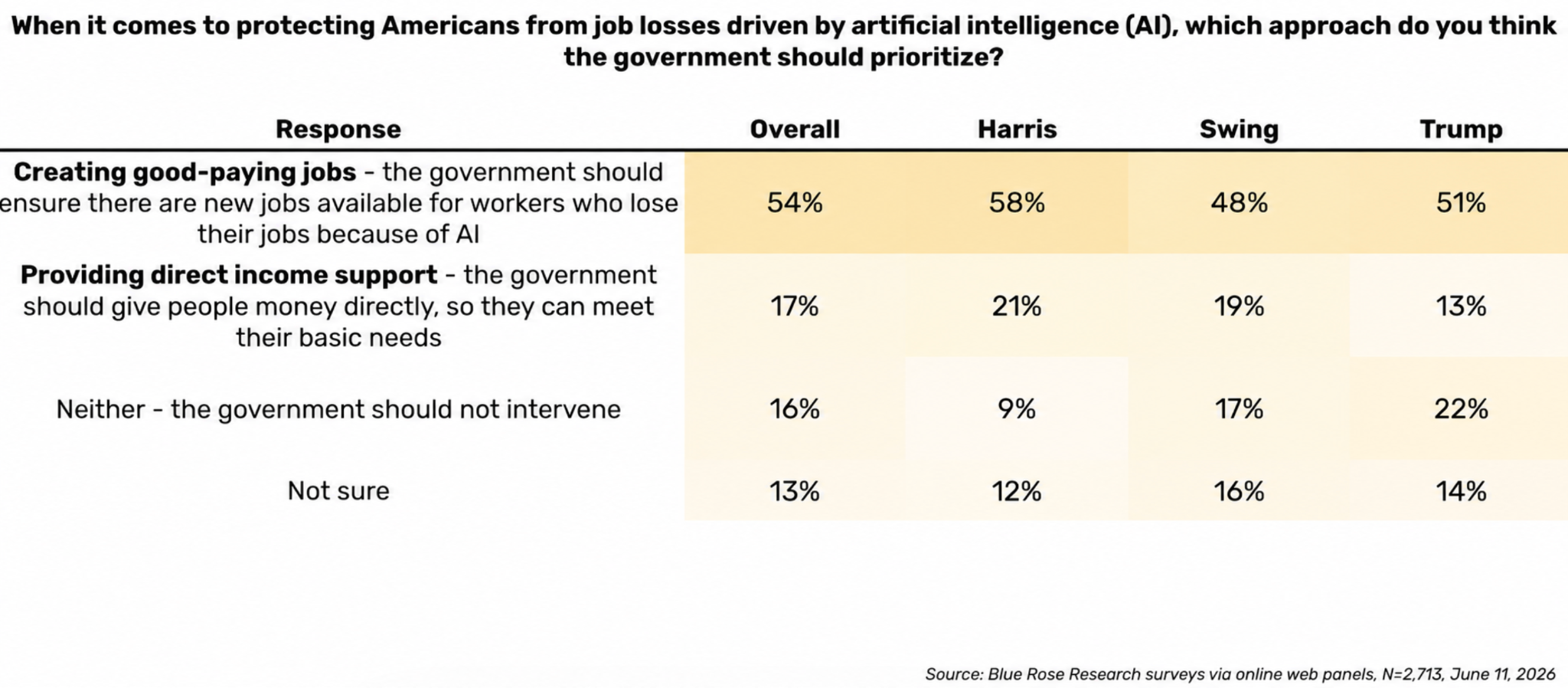
“Rendering humans unnecessary” is broad enough and it encompasses many different fears, so I want to focus on one of the most concrete instantiations of it: the fear of job loss. Anthropic’s 2026 Public Record survey of nearly 52,000 Americans revealed that 64% of the respondents said they were worried about A.I.-induced job loss, making it the single most common fear in every state. The words “job loss” might make it sound mostly about income, but I think this understates what’s at stake for most of the population. For work provides not only income, but agency, status, belonging and a sense of control over one’s life. So what underpins the fear here is not simply losing one’s paycheck, but rather the entire social role through which one has come to understand oneself. Existing polls support this interpretation. When Americans are asked whether they would prefer the response to A.I. to consist of creating good-paying jobs or providing direct income support via governmental programs, they overwhelmingly choose the jobs.
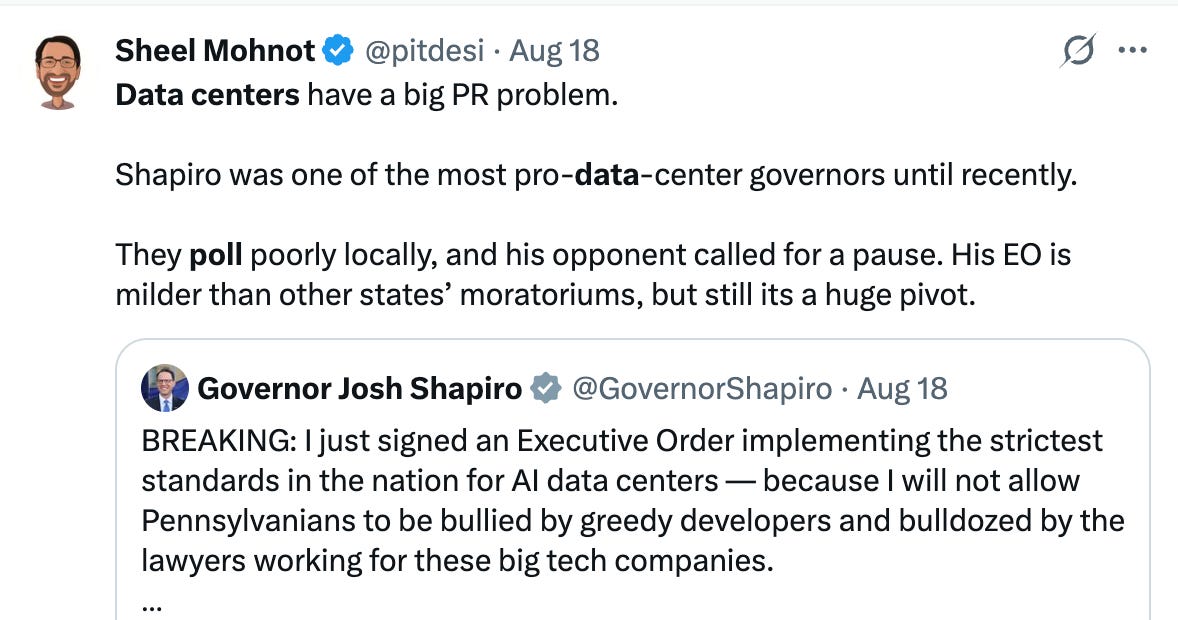
In response to the data center backlash, many tech leaders have started to panic. It has been concluded by many that this is a “PR problem” and that there needs to be at least some positive message regarding A.I. And although differences remain between the more “doomer” faction (think Dario Amodei) and the more accelerationist faction (think David Sacks), it seems there has been some convergence around what the ultimate weapon in the arsenal of pro-A.I. arguments should be: curing cancer; or, when people get really ambitious, even all disease.
My aim is not to resolve whether A.I. will in fact cure cancer (I have written elsewhere about the barriers to diffusion in the physical world), nor even whether we are truly facing some trade-off between such gains and other consequences, like mass unemployment (Again, economists have opined on this). What interests me here is the fact that we seem to have converged upon “curing cancer” as the ultimate good, as the One Thing that might redeem almost everything else. It’s interesting because it betrays something important about the background assumptions of our society: an impoverished conception of what human beings are and what ultimately makes for a full life.
Thinking that “curing cancer” will quell anxieties when the fear is ultimately about loss of control and agency, imagines humans principally as creatures with material needs and only that. As someone coming from a biology background, who considers “curing disease” as a very noble mission, I still believe that the vague promise of “curing disease” is fundamentally not worth it if it comes with a form of permanent deprecation of most humans’ existence.
I suspect many A.I. leaders instinctively understand this problem. Indeed, Sam Altman, the CEO of OpenAI seems to recognize this in a more recent interview. But “curing cancer” is so attractive, I think, because it is a good for which we still possess an intact moral vocabulary. A way to judge and value it. Over the past decades, perhaps even centuries, we have become increasingly articulate and adept at creating and valuing material goods: health, comfort, consumption. In parallel, our goals have re-oriented around the alleviation of suffering; and above all, the alleviation of physical suffering. By contrast, we are much less certain how to speak about dignity and purpose and what it means to live a life that is not merely long and comfortable, but actually worthwhile. Perhaps related or even causative of this broader transformation, the institutions and broader social structure that once supplied a language for such questions— religion, civic life — have all weakened. We are also living through a broad collapse of trust in the institutions that once helped societies understand themselves in a more intellectual sense: universities and the media or those who are expect to lead through periods of disruption: government.
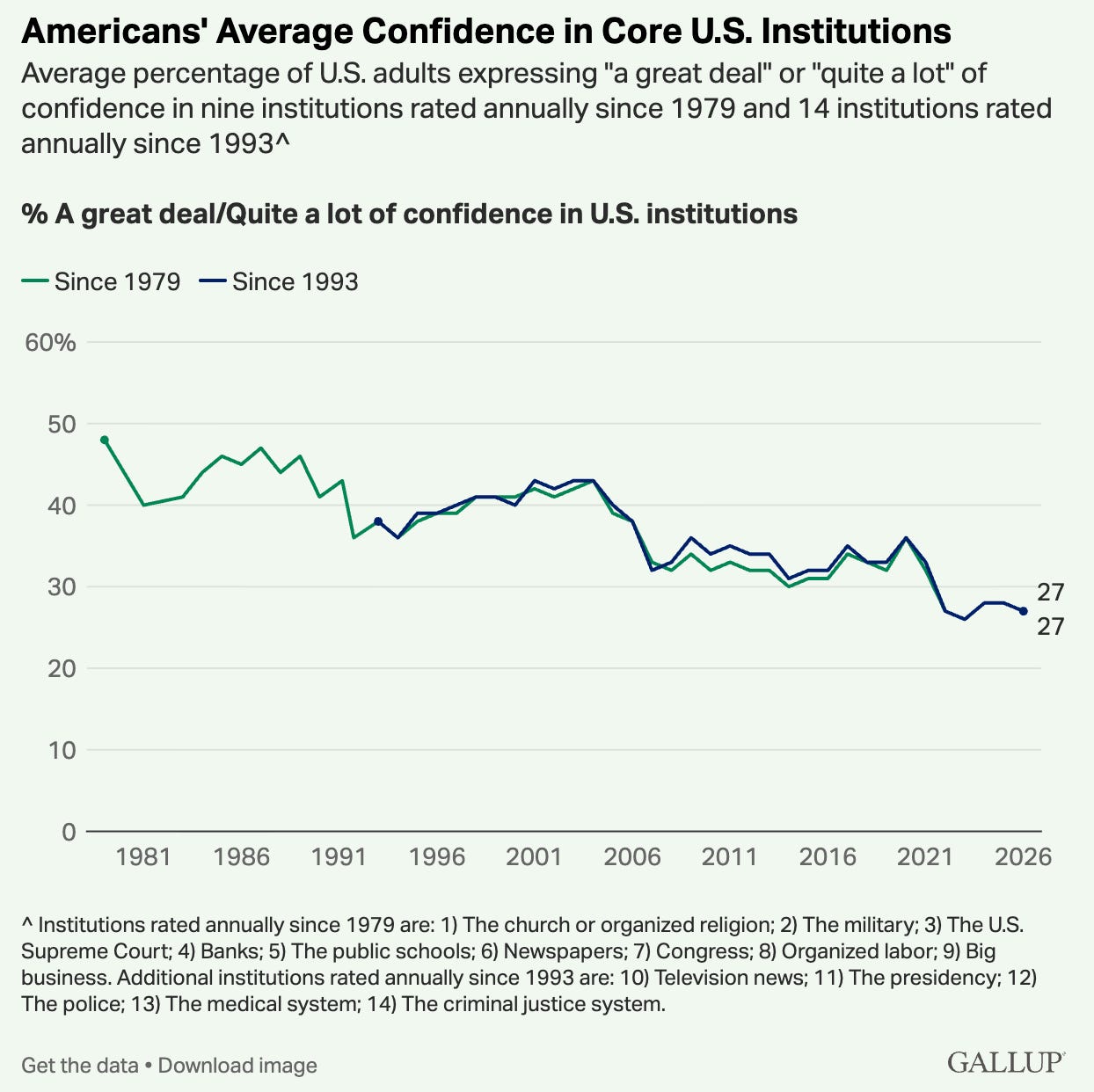
It is therefore unsurprising to me that we retreat to “curing cancer” as the ultimate salvation. It is exactly the sort of problem that can, at least in principle, be handed over to technocratic institutions and private actors and solved without requiring society to agree on very much beyond the proposition that disease is bad, thus asking very little of our moral imagination or institutional capabilities. Questions about the place of human beings in a transformed social order would be difficult in any age, but they might be especially hard in ours, when we seem to have lost much of the moral and conceptual vocabulary needed to make sense of them.
On what humans need
“In the end they will lay their freedom at our feet, and say to us, ‘Make us your slaves, but feed us.’”
These are the words of the Grand Inquisitor, in the famous story of the same name within Dostoevsky’s The Brothers Karamazov. Ivan Karamazov tells his brother Alyosha a parable in which Christ returns to Seville at the height of the Spanish Inquisition of the 16th century. He performs miracles and is recognized by the enthusiastic populace, who see his return as the pinnacle of the Church’s frenzied efforts in the Inquisition. But then, he is promptly arrested by an elderly cardinal, the Grand Inquisitor, who visits him in his cell.
Why would the representative of the Church imprison Christ himself?
The Inquisitor’s answer is that the Church has, in effect, improved upon Christ’s philosophy and that through his arrival, Christ was threatening the fragile social order that had been established, leading to a world less suited to the true nature of human beings and thus conducive to less happiness.
The Inquisitor believes Christ’s fundamental mistake was thinking too highly of mankind and offering man freedom at the expense of security. Freedom is noble, yes, but too high of a burden for most of mankind, who crave to be enslaved, but well-fed.
The Inquisitor sees the three temptations in the desert as the three great opportunities Christ gave away for making the world more fit for humanity’s true nature. Satan first tells Christ to turn stones into bread. Yet Christ refuses, placing freedom, spiritual and physical, over mere material security: “Thou shalt not live by bread alone.” Satan then urges Christ to throw himself from the Temple and be miraculously saved, to convince his followers of his holiness. Yet Christ refuses again, believing that humans should rely on their faith and handle uncertainty. Finally, Satan offers him dominion over all the kingdoms of the world. Yet Christ refuses worldly power, preferring that people come to him freely rather than through coercion.
In the Inquisitor’s interpretation, these temptations stand for the three conditions human beings crave above all: comfort, certainty, and relief from the burden of governing oneself. And by thinking too highly of mankind and refusing Satan, Christ was making the world worse. The Church has therefore “corrected” Christ by accepting what he rejected and giving humanity bread, certainty, and authority — even at the price of freedom and self-determination. As the Grand Inquisitor finally tells Christ: “What is that freedom worth, if obedience is bought with bread?”
Much of Dostoevsky’s work, far beyond The Brothers Karamazov, is haunted by the possibility that beneath all of humanity’s declarations of a desire for freedom, dignity, faith and transcendence, man may in the end desire something considerably simpler: that he should be fed, sheltered and relieved of responsibility. The thought that the great drama of human existence might culminate not in freedom, but in comfort, appeared genuinely horrifying to Dostoevsky. The Grand Inquisitor gives voice to this dear.
But almost two centuries after Dostoevsky wrote The Brothers Karamazov, the Grand Inquisitor’s anthropology has seeped into the background assumptions of our age. Human beings are increasingly imagined as creatures principally of material need: they want food, comfort, health and, above all, convenience. Give them enough of these things and surely they will consent to almost any rearrangement of the world around them.
In many ways, many of the more optimistic versions of the post-AGI future resemble a sort of Grand Inquisitor’s vision of utopia. This is a world in which disease is conquered, material abundance secured and almost every ordinary material want is satisfied. But at the same time, the institutions that allocate resources and determine the shape of the future increasingly operate beyond any human’s comprehension and without any need for their contribution. Most people become fluffy hamsters, well-fed and taken care of, but utterly insignificant. And there is notably a lack of humanness to all these scenarios: when Jeff Bezos discusses us conquering galaxies to create more geniuses, I can’t stop but wonder: what are these geniuses ultimately for?
The argument that this would not be such a bad trade are often stated quite openly. The economist Alex Tabarrok (with whom I agree on most topics related to health policy), has suggested that even widespread displacement by A.I. need not be alarming if it is accompanied by sufficient abundance. After all, if jobs go away, it means that everyone will have endless material goods that are also surprisingly cheap.
In an interview with Zanny Beddoes, Editor-in-chief of The Economist, Elon Musk has made a related economic argument, predicting that A.I. will be radically deflationary, thus making goods and services extraordinarily cheap. Musk, of course, also worries about A.I., but, it seems to me, chiefly in the apocalyptic register: whether the machines might destroy humanity altogether. The question of what becomes of human significance at all remains largely unaddressed.There is a telling moment in the interview when Beddoes tries to pin Musk down on what happens during the transition. Beneath the economic question lies a deeper one: what happens to human meaning itself? Musk largely evades it, repeatedly retreating from questions about human purpose to easier questions about material provision and our technological future.
And although a Grand Inquisitor-like vision of what constitutes a good human life seems to be increasingly common, it is perhaps nowhere more pronounced than in Silicon Valley, the birthplace of modern A.I.
Much of the Valley’s great economic achievement has consisted in becoming extraordinarily good at satisfying the needs of the flesh: making things faster, easier, cheaper and more comfortable. Sometimes the results are genuinely wonderful: Waymo gives you back the hour you would otherwise spend driving and also increases safety; what’s not to like? Sometimes they are rather less so: a new generation of prediction-market companies has applied technology to construct what are, in practice, unusually frictionless gambling machines.
None of this is an argument against satisfying material needs. These are important advances for a civilization and they can provide the necessary conditions for the elevation of the human spirit. That being said, it may be that pursuing such ends daily shapes in a rather odd way what might be considered worth pursuing and doing for most people. There is, of course, an odd contradiction here. The means of technologists are frequently spiritual, even though the ends, which is the products they make, remain material. Silicon Valley is full of people possessed by an almost religious desire to transcend ordinary human existence, while the machinery they have built is exceptionally good at supplying ordinary human appetites.
Taken to its extreme, such an attitude produces Bryan Johnson, the influencer known for trying to achieve immortality. There is something almost monastic about the discipline with which he pursues longevity: the rituals, the renunciations and the subordination of ordinary pleasure to a higher purpose, all have a religious character. Yet the higher purpose is, in the end, merely an extension of biological existence. For Bryan Johnson, the means have acquired the intensity of religion, while the ends remain fundamentally materialist. And while he, himself, is living a fundamentally spiritual experience, what is transmitted to the wider culture is largely the object of that devotion without the devotion itself: a longer-lived body.
Something similar appears in the race to build A.I. For many of those who are creating A.I., the act itself has acquired an almost religious significance. People speak of superintelligence in eschatological terms, speculate about the “consciousness” of models and imagine the arrival of what is called the “machine god.” But none of these religious experiences are available to the humans on whom this “gift” is bestowed upon. The religious experience belongs principally to the builders and what is offered to everyone else is the product of that faith. In turn, this product seems to scratch all the material needs but none of the spiritual ones.
This might help explain the genuine bewilderment with which some A.I. advocates encounter public unease. I recently attended a small conference devoted, more or less, to the problem of “meaning in the age of A.I.” At one point, a participant asked, with visible exasperation: “We are telling them we are curing cancer. What other promises do we need to make to show them the positive possibilities?” Someone in the audience proposed an answer. Perhaps, he suggested, they should make more videos of people who had been cured of cancer. Human beings, after all, are not always persuaded by words.
But I believe this whole way of approaching the problem is mistaken, or at least incomplete. If the discussion is to become genuinely serious, it may have to begin from assumptions rather less like those of the Grand Inquisitor and rather more like those represented by Christ, in Dostoyevsky’s writings.
What if man does not, after all, wish merely to be fed, protected, entertained, and spared the burden of necessity? What if he also wishes to remain the author of his choices and circumstances?
On what work means
In a recent essay, computational biologist Mohammed AlQuresh argues that if A.I. eventually renders human labor economically superfluous, one of the biggest problems we will have to face is not material deprivation, but meaning. More specifically, how to preserve for human beings some genuine role in the intellectual advancement of civilization, perhaps even by enhancing our intelligence so that we remain participants in intellectual progress. It is already a considerable improvement on the more impoverished discussion in which the problem of work is reduced to income and the answer to its disruption, accordingly, to redistribution.
And yet the essay seems to me to retain one very flawed assumption:
“I would guess that most people (80-95%?) do not find meaning in work yet currently have to work to survive. If we safely and successfully transition to a post-required-work, post-AGI society, this large majority will be better off, living meaningful lives without the drudgery of non-purposeful work.”
This statement is wrong, even on the very surface.
I think maybe as a form of coping, intellectuals sometimes flatter themselves with the idea that work is a burden endured by everyone else, while they alone are fortunate enough to find meaning in it. But the evidence suggests otherwise. Most Americans report deriving at least some meaning or satisfaction from their work; roughly 70 percent say their job gives them a sense of purpose. About half of workers report being highly satisfied with their jobs, and as many as 39 percent say their work is central to their identity. Something that gives you a sense of purpose can be nonetheless very unpleasant. But 51 percent of Americans also say they are highly satisfied with their job.
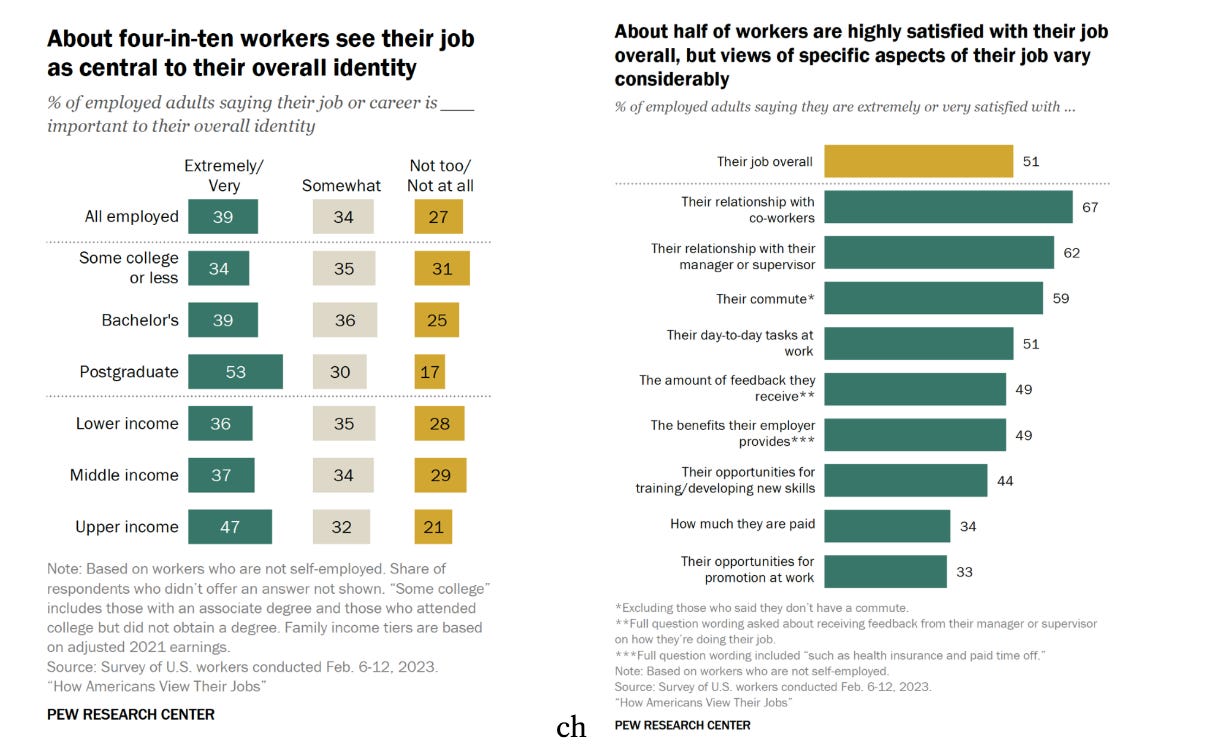
As a matter of fact, it is simply not true that most people dislike their jobs or derive no meaning from them, even when those jobs may look unappealing from the vantage point of an intellectual. But I fear that a world of mass unemployment would be destabilizing in ways such surveys do not capture, because they only reveal how much people appreciate jobs at a first-order level. Whereas there are many second-order functions of work that they somewhat take for granted when replying to such surveys.
A job is not merely a bundle of tasks that one enjoys or not. Around it sit a myriad of deeply intertwined social functions like status, independence, recognition, bargaining power, advancement, obligation, and the sense of being needed by others. If we step one level further from the individual, to the societal level, work may even be one of the foundations on which modern political equality rests. A society in which most people possess some economic leverage may allow very different political arrangements compared to one in which a large share of the population is materially supported, but not actually needed.
A book could be written about these social and political embeddedness roles that “work” has, so I will not aim to be exhaustive here. Instead, I will focus on three dimensions that seem especially important: the role of work in social mobility and its deeper role in the American conception of the self, the relationship between human labor and political rights, and the place of work in sustaining agency and independence.
First, work is about the possibility of social mobility and making a better life for oneself. The notion that work is not merely a means of subsistence but a means of becoming something and that through labor a person might alter not only his circumstances but, in some sense, himself, is very old in the American imagination and dates back to the Founding Fathers. They imagined the republic, at least in its nobler self-conception, as a place in which a man need not remain forever what birth had made him. This was in direct contrast to the entrenched aristocracy of the European states, an arrangement whose rejection stands at the roots of the founding of America.
In an 1813 letter to John Adams, Thomas Jefferson is very explicit about this intent and distinguishes what he calls a “natural aristocracy” based on “virtue & talents” from an “artificial aristocracy founded on wealth and birth,” the latter of which was dominant in Europe. Many of Jefferson’s proposed policies and legal arrangements are made to catalyze such an ascension from the artificial to the natural aristocracy of the deserving ones. The system of public education is an example. He wanted promising children to be selected upward from local schools through higher levels of education so that, as he put it, “worth and genius would thus have been sought out from every condition of life” and prepared to compete against the advantages of birth for public office.
Labour became a founding virtue of American life. Writing in the 1830s, Tocqueville observed that in the United States “all honest callings are honourable” and that labor was regarded as the “necessary, natural, and honest condition of human existence.” In his account, the fact that work itself carried not only carried no stigma, but was actually admired, with even the wealthy being expected to be visibly occupied rather than live as an idle rentier class, is what distinguished Americans from Europeans. By Lincoln’s time, this had developed into the ideology of “free labour.” In his view, being a wage worker was not a desirable end in itself. But wage labour was a temporary station on the struggle to independence and the beauty and value of the system was in allowing such struggle to take place.
I think people can endure a surprising amount of inequality if they believe the hierarchy remains penetrable. Indeed, in many ways this is the American dream. I want to return to the poll where Americans are asked whether they would prefer the response to A.I. to consist of creating “good-paying jobs” or providing direct income support and they overwhelmingly choose the jobs. I think an aspect to this answer is that “income support” hardly evokes abundance. But there is still something revealing in the result. Most Americans do not themselves occupy what we would ordinarily call highly paid jobs; if “good-paying” means, say, an income in the top quarter of the distribution, then by definition most respondents are choosing an outcome they may never personally attain. But it seems like the possibility itself is motivating to people.
Second, work is, among other things, one of the principal ways human beings acquire mastery and can climb status hierarchies, within discrete occupations, gaining progressively a greater feeling of control. Careers often begins with small tasks and relatively limited discretion. Then, as employees develop their judgement, they gain more power. One learns the thousand minor particulars of a domain, develops instincts that are difficult to formalize, so-called “taste”, and is eventually trusted with decisions that would once have been above one’s station. The career ladder thus becomes a ladder of agency.
This is why so many careers seem, from the outside, to become progressively less about doing the thing itself and more about deciding what should be done; why in many domains, the higher one climbs, the more their job converges upon “manager.”
An important feature of work, viewed in this way, is also that it provides relatively discrete and intelligible hierarchies of status to climb. A person can become an excellent contributor within a particular institution or community and derive status from his position within that bounded world.
And I think there are strong reasons to think that bounded hierarchies matter psychologically. One proposed explanation for the harms of social media is that it radically expands our comparison set such that, instead of comparing ourselves primarily with colleagues, neighbors, friends, and other people within a relatively small social world, we are exposed continuously to the most successful, and accomplished people drawn from populations of millions. To the extent that one believes in such things, research also consistently finds that such upward social comparison on social media is associated with greater anxiety & depression, as well as lower well-being.
And I also think there is a broader, societal problem that would result from breaking such ladders of progression. If A.I. removes the lower and middle rungs, it would lead to the loss of training of “judgement”, and thus would undermine the process by which human beings become capable of exercising authority. Assuming, that we still intend at least *some* humans to make consequential decisions in the future, this seems troubling.
And lastly, I want to discuss something that I think most humans fear instinctively.
There is also no obvious reason to assume that, in a world without human labor, most people would retain the same political rights they possess today. Labor can also be considered as leverage, such that when workers control something society needs, elites have a reason to bargain with and extend concessions, including in the form of political rights. But if human labor ceases to be scarce or valuable, that source of bargaining power may disappear.
I believe history gives us some strong reasons to take this possibility seriously. There are several episodes in which greater labor scarcity increased workers’ bargaining power and was followed by broader economic or political concessions, including in expanded rights. But if scarcity can strengthen the political position of workers, it seems to me entirely plausible, and indeed, likely, that a world in which their labor is no longer needed, could, conversely, weaken it.
One such instructive episode is the Black Plague.
The Black Plague of 1347–53 killed an enormous share of Europe’s population. In England, for example, the population is estimated to have fallen from roughly 5.5 million in the mid-1340s to about 2.5 million by the 1370s. One important effect of this was to transform labor, including manual labour, from an abundant and cheap resource, into something quite scarce and valuable. As a result, workers could demand higher wages and refuse bad terms. This in turn, appears to have had broader effects than just better lives for workers in the moment. It seems to have changed institutions and the political order more broadly.
Haddock and Kiesling, for example, argue that by raising the marginal value of human labour, the Black Death put enormous pressure on feudal institutions, which in turn accelerated the development of workers’ rights over their own labor and the erosion of serfdom. And on top of this, the broader economic-history literature similarly identifies the decline of serfdom in Western Europe as one of the plague’s major long-run consequences.
It may well be that widespread job loss never materializes. That is not the point of this exercise. The point is that figures like Elon Musk are openly predicting it, while we have remarkably few serious answers — or even serious public discussions — about what should follow. And no, framing this as a “PR problem” does not count.
That is not to say that discussions approaching this don’t exist – earlier this year, Phillipp Trammell Dwarkesh Patel published an essay asking what policy should look like in a world where human labor is no longer economically important and capital becomes the dominant source of income and power. They consider various economic mechanisms that might prevent such a transition from producing an extraordinary concentration of wealth and political power. But they are few and far between and it seems like our political institutions are too exhausted and battered to do much about this, anyway. And it also seems to me that these discussions are mostly about policy, rather than about building anything resembling a broader moral framework or organized system of meaning.
An earlier version of this essay contained a constructive message: if what we are lacking most in this era are the sense and meaning making institutions, maybe what we should focus on is building those. But this seems like a long term project and what is coming seems much too furious, much too all-encompassing and much too fast for that. I wonder if in these conditions it is holy at all to proceed….
There is something communist/socialist-adjacent to the AI abundance movement: "in the end, you won't have to work; we'll live in paradise".
Death is not an evil. Life is not possible without it. But how we livw and die matters enormously.