

I am not the first to notice that the moral imagination of the modern world feels, in certain respects, flattened. Not long ago, after immersing himself in nineteenth-century novels, Matthew Yglesias remarked on how foreign the language of honor now sounds to us and how distant from the moral world of someone like Dorothea in Middlemarch. Think about it: when was the last time you praised someone for being noble or honorable? Even “good” has been replaced by the epithets “kind” or “nice”.
The ends we pursue now tend to cluster around three dominant aims: safety, utility, and equality. Of these, only equality still gestures toward something like a moral ideal; the others are entirely managerial and materialistic in nature.
Having noticed this, I began to wonder: why equality? Why the persistent fixation on oppression and the moral drama of victim and perpetrator? Why, out of all the possible goods, has this one become so central?
Nietzsche suggested that egalitarianism was the afterglow of Christianity—a moral residue lingering after faith itself had faded. But Christianity bequeathed many values to the modern world: humility, charity, forgiveness, self-sacrifice. Why did equality, in particular, survive as the organizing principle?
It seems to me that equality functions as a kind of consolation prize in a secular age. The shift from an “enchanted” premodern cosmos to a “disenchanted” secular order has undoubtedly expanded individual freedom. But it has also led to a casting off of the old metaphysical scaffolding and in doing so, it has stripped the so-called “losers” of society of any sense of inherent dignity rooted in feeling like they belong to a larger cosmic story.
In a disenchanted world, the individual ends up carrying an immense psychological burden of responsibility, as outcomes appear to flow almost entirely from human choice. Nothing is “meant to be” or cosmically allotted, leading to the natural conclusion that each individual gets what they deserve. Winning and losing become not merely the vagaries of fate, but are often implicitly understood to be a mark of one’s inherent worth.
It seems then to me that the contemporary fixation on oppression narratives, which is closely allied with the language of equality and often emerges from the same moral circles, can be understood, at least in part, as a response to this psychological strain that modernity places on the self. More specifically, by offering a framework where the cause of failure is attributed to unfair structures of domination beyond one’s control, it offers some sort of a reprieve from being held wholly accountable for one’s fate.
Man shall not live by bread alone
“She appeared at daybreak one rainless morning, at the top of a hill on the road from Quijingue, carrying a wooden cross on her back. She was twenty years old, but she had suffered so much she looked ancient. She was a woman with a broad face, bruised feet, a shapeless body and mouse-colored skin (…)
She had cut all her hair herself after being raped for the fourth time.”
So begins the story of Maria Quadrado in The War of the End of the World, one of Mario Vargas Llosa’s most ambitious and unsettling novels. On her journey through the Brazilian backlands she is violated repeatedly — by a constable, a cowboy, two hunters, and finally a goatherd who had offered her shelter. The first three times she feels only revulsion and prays she will not be left pregnant, but the fourth time she actually feels pity for her assailant. She ends up being horrified by this flicker of compassion and she punishes herself by cutting off her hair.
Maria Quadrado is not an isolated tragedy in the novel, but one among many broken figures who gather in the doomed settlement of Canudos. Set in late nineteenth-century Brazil, the novel recounts the rise and subsequent annihilation by the Brazilian army of this community. In Canudos, the destitute and displaced of the world assemble around a wandering ascetic known as the Counselor. The inhabitants of the settlement are former slaves, bandits and prostitutes. In other words, all sorts of “failures” for whom the promises of the modern republic, which is secular, rationalizing and impatient with religious fervor, mean very little.
Throughout the novel, a pervasive question lingers: what does the modern world offer to such people? While the republic promises progress, order and rational administration, these abstractions do not feed the souls of “the wretched refuse” that constitute the citizens of Canudos. In this social order, they would be losers anyway.
They gather around The Counselor because he offers something the Republic cannot. He does not promise comfort or prosperity, but dissolution — the surrender of the isolated self into a transcendent design. And he encourages this dissolution quite explicitly:
“Although he mentioned God and said that it was important for the salvation of a person’s soul that the person destroy his or her own will - a poison that gave everyone the illusion of being a little god who was superior to the other gods round about him – and put in its place the will of the Third person, the one that built, the one that labored, the Industrious Ant, and things of that sort, he spoke of these things in clear language, every word of which they understood”.
In Canudos, the wretched give away their will and in return, they are no longer superfluous. Instead, they inhabit a cosmic narrative, brought on Earth by the Counselor.
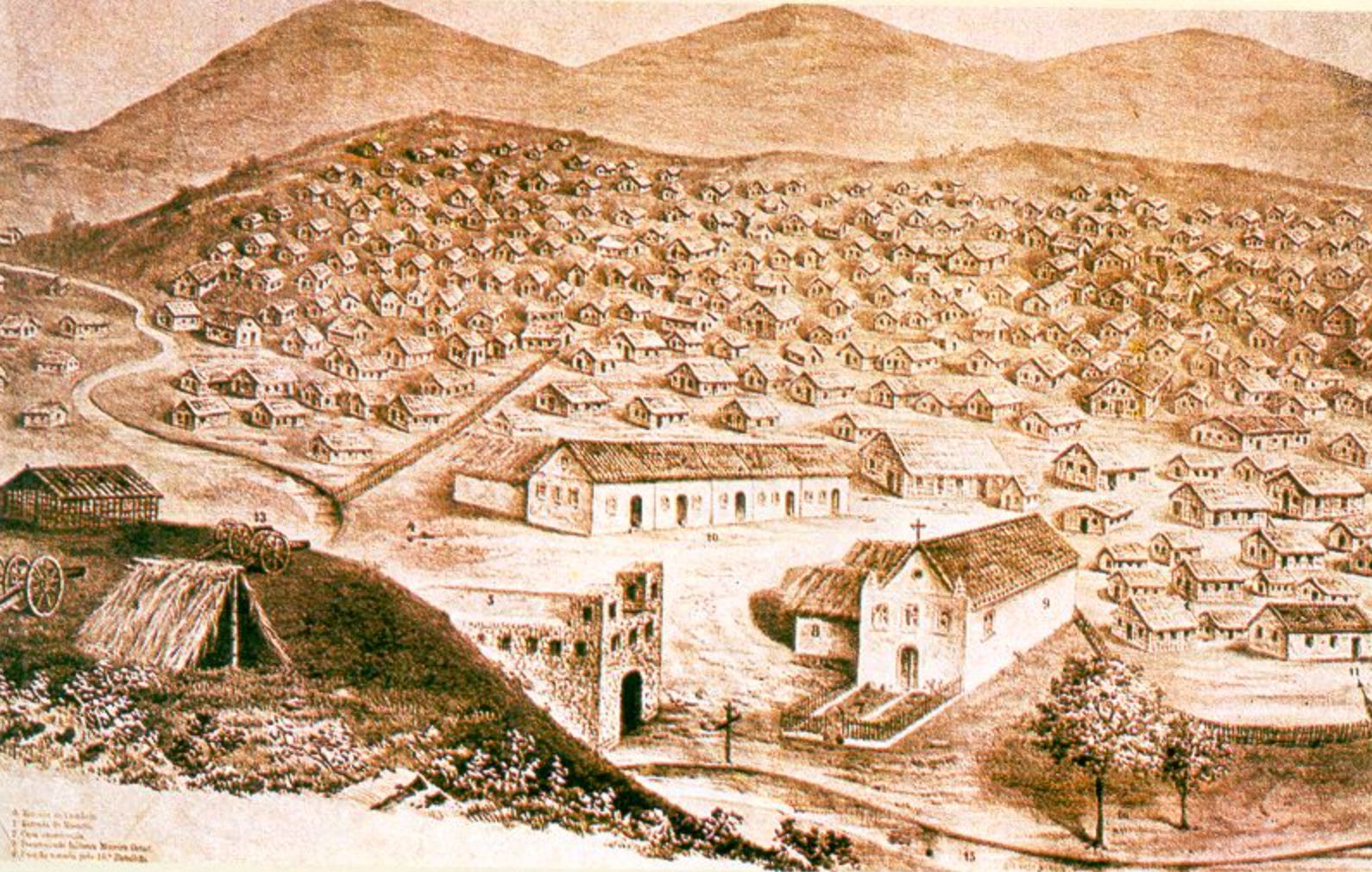
The newly established Brazilian Republic interprets Canudos as a threat to order and modernity and so dispatches military expeditions to crush the settlement and its inhabitants. Yet the Republic is slow to get what it wants: again and again, these better-armed and professionally trained forces falter against the ragged defenders of the town. The defeats acquire an almost fantastical quality: a modern state, armed with technique and confidence ends up defeated by a people who possess little but belief.
For a brief season, the annihilation of the isolated will seems to generate a force capable of holding even the republic’s army at bay. And yet Canudos ultimately falls. Surrounded, starved, and overwhelmed, it is finally obliterated.
The disenchanted world
The inhabitants of Canudos are not equals in any modern sense. The settlement does not rest on the fiction of symmetry. It is hierarchical, ordered and shaped by charisma and submission.
One of the Counselor’s most impressive powers is that he is capable of making men who once lived by violence and appetite — the bandit Pajeú among them — bend before him, without the need for coercion. Their obedience arises as though it were the most natural fact in the world. What he offers to them is simple: in Canudos, each person occupies a place, and that place, however lowly, is intelligible within a sacred whole.
The disenchanted, secular world has killed Canudos for most people. So what is left for them? As a consolation prize, a sterile “equality.”
In a disenchanted world, a world that has lost its connection to transcendence, an obsession with equality is born out of a desperate structural necessity. This is the only remaining safety net preventing the autonomous self from sliding into total dehumanization.
In A Secular Age, the philosopher Charles Taylor offers a remarkable account of just how foreign that land of the past truly is. His ambition is sweeping: to illuminate the shift in the unspoken assumptions that structure our experience of the world, which happened during the transition to modernity. These assumptions lie prior to philosophical reflection. They are, as Taylor puts it, “the way we naively take things to be (…) the construal we live in without ever being aware of it as a construal.”
According to Charles Taylor, modernity is marked not merely by a decline in religious belief, but by a profound transformation in our imaginative horizon. What he calls the transition from an enchanted to a secular world is this shift in how the world is experienced.
In the pre-modern “enchanted” world, the world of “spirits, demons and moral forces”, reality was thick with agency and meaning. The cosmos was not neutral or inert, but perceived as constantly impinging upon humans. In this vision of the world, human beings were vulnerable to forces beyond them, open to both corruption and elevation by powers that exceeded their control.
Taylor describes this as the condition where the boundaries between the self and the world are vulnerable, the so-called porous self. This porous self that was embedded in a morally charged universe and was susceptible to outside influence, while being conscious of its dependence within a larger, divinely structured order. That dependence came with a recognition of a certain impotence, but it also conferred belonging. One’s life was situated within a cosmic order not of one’s own making.
Disenchantment dissolves this structure. What disappears is not simply belief in spirits, but the very sense that meaning resides in the fabric of the world. The modern cosmos becomes impersonal and governed by physical laws that can be scientifically deciphered. The locus of meaning is relocated from the world to solely inside the human mind. Thoughts, feelings, aspirations — what Taylor calls “fullness” — are now understood to exist only within human minds.
This gives rise to what Taylor terms the buffered self. The buffered self encounters the world from behind a kind of protective membrane. As a result, it is no longer vulnerable to cosmic forces. To the buffered self, nature is no longer enchanted, but inert and in addition, available for explanation and manipulation through the powers of science. Even when we acknowledge the limits of our powers as humans, the dominant modern posture assumes that natural obstacles yield, eventually, to technology and science. We do not propitiate unseen powers for a good harvest. Instead, we now design irrigation systems and engineer crops.
The advantages of a buffered self and of living in a disenchanted world are clear: no longer do we feel a sense of helplessness in the face of the powers of nature. No longer do we feel like our very destinies are at the mercy of Gods. The modern, buffered self can control fate itself. We are Gods on Earth.
Yet, in my interpretation, with such immense empowerment comes a crushing burden: that of radical responsibility. Once we anchor meaning within the individual and we understand him to be radically able to improve his condition, there is no longer any refuge to be found in helplessness. The secular mind implicitly understands power and merit as matters of will. The loser is solely responsible for their condition.
This goes the other way too. In earlier times, even the powerful, kings included, understood themselves as subordinate to God. Now, it is one’s talent and will, or agency, if one is to speak in currently popular terms, that brings about their fortune.
There are many other ways, in my mind, in which the disenchanted world makes things hard for the “losers” of this world. One obvious loss is eschatological. In the older, enchanted imagination, earthly failure did not exhaust a life’s meaning. The poor, the humiliated, the obscure could inhabit a story whose resolution lay beyond mortal time. Salvation, not success, was the final measure. An inversion of status, even, was heavily hinted at: “Blessed are the poor in spirit, for theirs is the kingdom of heaven.”
Yet disenchantment also robs “the weak” of dignity in this life. In the enchanted world, society was as it was due to a divinely ordained order, as per Taylor: “A kingdom could only be conceived as grounded in something higher than mere human action in secular time. And beyond that, the life of various associations which made up society, parishes, boroughs, guilds and so on, were interwoven with ritual and worship (...) One could not help but encounter God everywhere”. In this divinely ordered world, one’s station, not matter how limited, was not arbitrary, but was understood to participate in a cosmic design.
Medieval society could thus be imagined as a hierarchy of complementary functions: the clergy praying for all, the lords defending all, the peasants laboring for all. The roles were unequal in honor, yet mutually necessary. Even the humblest life had intelligibility within a larger whole.The buffered, modern self stands in a different landscape. There is no divinely ratified structure into which one is fitted. There is only the immanent frame: a social world understood as the product of human construction, revisable and contingent.
What, then, consoles the weak? Very little. Without transcendence, there is no deferred compensation. Without a sacred order, there is no given place of inherent dignity that one might inhabit in the world. And with radical responsibility comes the realization that some might “deserve” to be the losers of this world.
And more disturbingly, without all these, it becomes difficult to resist the conclusion that some lives contribute less, matter less and perhaps even, are less necessary.
It is in erecting barriers to reaching this conclusion that post World War II modernity’s moral energy gathers. The relentless pursuit of equality, the acute sensitivity to oppression and the refusal to accept hierarchy as natural are not merely fashions. They are attempts to supply, through political means, what religion once provided: an assurance that no life is negligible. In a world where dignity no longer descends from heaven, it must be constructed on earth. Or else the weak are left with nothing at all.
The classical liberal dilemma
We still glimpse fragments of enchantment in modern life. Meaning has not entirely disappeared and in fact, it is now most accessible through work; the most meaningful work is that which presents itself as larger than the individual and as participation in a mission, rather than the mere earning of a wage.
Nowhere is this more visible than in start-ups. Perhaps not coincidentally, in such places even the pretense of equality is often suspended in practice and done away with quite easily. Employees willingly subordinate themselves to a founder, often investing that figure with a quasi-prophetic aura. An entire mythology around the figure is born. "Founder-mode” might be the closest we get in the modern era to a grand hero narrative.
This hierarchy is accepted, even celebrated, because it promises belonging to a grand narrative: building the future and bending the arc of history through innovation. In recent years, companies like Anthropic have inspired precisely this kind of near-religious devotion in their employees.
For the fortunate, this becomes a form of salvation. One may dissolve oneself into “the mission”, much like the inhabitants of Canudos.
But such salvation on Earth is rarely available to “the weak”. It is no wonder that it is in modern America, where meritocracy has taken perhaps its most uncompromising form, where the psychological weight of absolute personal responsibility is the heaviest. The Statue of Liberty may welcome the “wretched refuse,” but even that promise seem to carry an implicit demand: that they make something of themselves and ultimately succeed.
The final excuse disappears. For those less endowed by talent or circumstance and for those who chose poorly, possibility itself can become more of a burden.
The high-IQ classical liberal often fails to perceive the existential strain this creates. He speaks of growth, mobility and opportunity and of the long arc of history bending favorably. In doing so, he resembles the bewildered journalist at the end of The War of the End of the World, who confronts the doomed inhabitants of Canudos with incredulity: “I don’t understand, I don’t understand. What sort of creatures are you all anyway? What are you doing here, why didn’t all of you flee before they had you surrounded? What madness to wait in a rat trap like this for them to come kill you all!”
And the reply, given by the deformed Lion of Natuba, cuts through the incomprehension: “There isn’t anywhere to flee to. That’s what we kept doing before. That’s why we came here. That was the place we fled to.”
There is nowhere left to flee and retreat to. The secular age has dismantled the old sanctuaries that once shielded people from the full weight of responsibility. There is nowhere to hide from the self. And in the absence of a grand narrative, sterile equality is itself a rather pathetic consolation prize.
I would like to thank Patrick Collison for reading early drafts of this essay and other related writings.
I gotta be honest I’ll take my equality as my consolation prize. I like my personal freedom, and I like crazy modern ideas like “women shouldn’t be violently subjugated because religious texts from thousands of years ago said its natural and divine.” Its scary to reckon with the fact that our social world and very reality is so changeable. But it is the truth, and the sheer number of different cultures and religions and languages that humans have developed over history prove it.
Anyone who needs structure and a grand cosmological moral narrative can turn to religion, and they often do. I am happy for them! And I’m happy that I’m not forced into it. Carrying the weight of the self can be a heavy burden, and there are plenty of places to put it down. Religion is a great place, but if its the only organizing force in society, it tends to forsake a lot of people in the process.
That being said, I don’t think its accurate to say the tradeoff for a meaningless secular world is equality. Plenty of religious cultures had some sort of belief in equality or adjacent ideas. Even the big dominating religions of today demand tithing as a leveling mechanism to help others.
I also don’t think secularism leads to meaninglessness. I am the counterexample - my life is full of meaning and beauty and I don’t desire a grand narrative or fate or place within the universe. Just a life of earthly pleasures like observing the seasons, swimming in a cold lake, laughing with my loved ones, sleeping easily after a day of labor. Dignity - whether that comes from secular morality or religion - is what I demand. And dignity does not feel like relegating someone to a low social class and then telling them it’s meaningful after death.
Anyway, thanks for the essay - its given me a lot to think about and I’m not even close to putting down these ideas.
This is a truly remarkable essay. Astonishing, even. I'm sure I'll still be thinking about this argument years from now. There have only been a few times in the past where I read something that instantly illuminated some hitherto dark corner of our collective psychology, and this was one of them. Thanks so much for writing it, Ruxandra.
The internal/external locus of control has been picked up before as being a part of the psychology of leftism, along with several psychological disorders. Believing that your life is just a sequence of events managed by the gods is surely comforting for the weak, but it also neutralizes those who could have been strong and creates a lot of dysfunctional behaviors (in the limit, it creates things like child sacrifice). Even basic things like personal hygiene don't make sense if you view epidemics as a random dice roll from the heavens. And I doubt you can mount the kind of intensity and long term planning capacity we see in men like Elon Musk if your culture thinks outcomes are already decided by fate. It's surely not a coincidence that after millennia of stagnation capital-p Progress kicked off only once people became secular.
There are some connections here to my own most recent essay, "Leftism is just ancient instincts". https://penbroke.substack.com/p/leftist-behavior-is-just-ancient
I don't cover the equality drive (which is a weakness of the essay), but do argue that a lot of modern far left behavior that looks irrational would have been rational in the tribal world we evolved in. For example, tribal gods aren't concerned with honesty at all. It isn't until the start of proper trade networks around ancient Egyptian times that we begin to see gods who punish dishonesty in the afterlife. Tribal gods are however very concerned with the accurate following of ritual. This makes sense: ancient tribes are at the mercy of many forces they don't understand and can't control like weather, tectonic activity, volcanoes, the luck of the hunt. A very external locus of control is just realistic and probably required for keeping morale up, but that forces them to encode learned knowledge as rituals supplied by the gods. It can't be, "I figured out how to make manioc edible, follow my instructions and you will survive", it has to be "the holy ritual has these steps and the gods will punish you if you don't follow their instructions". As civilization and consciousness develop we start to see human knowledge become more important, and the gods start penalizing low-agency behaviors like child sacrifice.
So many big questions posed by this. The biggest being, what to do about it?
It's possible that there is just no solution here. Reassuring the weak / benefiting from the efforts of the strong seem to be fundamentally in tension. The more your culture validates being a loser, the less motivation there is to become a winner. E.g. fat shaming is a healthy social behavior because being fat is bad for people; if such people view their condition as outside their control (it's the evil food corporations that did it to me!) then they can't take the necessary steps to become healthier.
So perhaps the best way to view it is that the healthiest society is one that creates enough opportunities for everyone to 'win' on their own terms, to win social status via activities that are hard to lose at. Our society has many such mechanisms already. The huge praise given to jobs for which there's unlimited demand, like entertainers, is just one of those. The prevalence of "fake email jobs" might be another. It becomes an optimization problem. Can society generate so many roles at which it's impossible to lose that everyone can feel self respect and like they have a place in the world, without diverting too many resources away from the strong who genuinely push things forward?