

AI companies are now racing towards recursive self-improvement1: the point at which AI begins to improve itself, setting off what some call an intelligence explosion and others, more grandly, the creation of “a machine god.” Against this backdrop, an interview by Palisade Research with Tao Lin, a researcher on Anthropic’s safeguards team, recently went viral on X. In it, he explains calmly that due to AI advances, nearly every human on Earth will become permanently unemployable and reliant on government welfare. The interviewer points out that this will make people angry, and Lin agrees: “People should be angry at me and everyone else developing AI.”
This is said with little emotion, in as detached a manner as one might report the weather, purely as a statement-of-fact. Lin even goes on to expound why the anger need not worry him: “We live in a bubble. I won’t meet those people.” One could read this as indifference. But it can also be seen as the natural result of building at the frontier, among a very homogenous and relatively small group of similarly-minded people, racing towards being the first to build one of the most consequential technologies and wanting to get it right, in order to usher utopia. When a technology moves this fast, you are the center of it and the stakes seem so high, the rest of the country and their preferences can easily become an abstraction.
Still, the people Lin will never meet will live in the world he is helping to build. A future is being drawn up for them in the thin, bright air of the San Francisco hills, and it seems worth coming down from them to ask what everyone else thinks of it. The polling firm Blue Rose Research has done just that. It asked slightly more than 2,000 Americans, selected to be representative of American adults2, about the futures the labs describe as success. These aren’t the catastrophic scenarios, where we all die, but the hopeful ones, held up by the labs as the reward for getting this transition right.
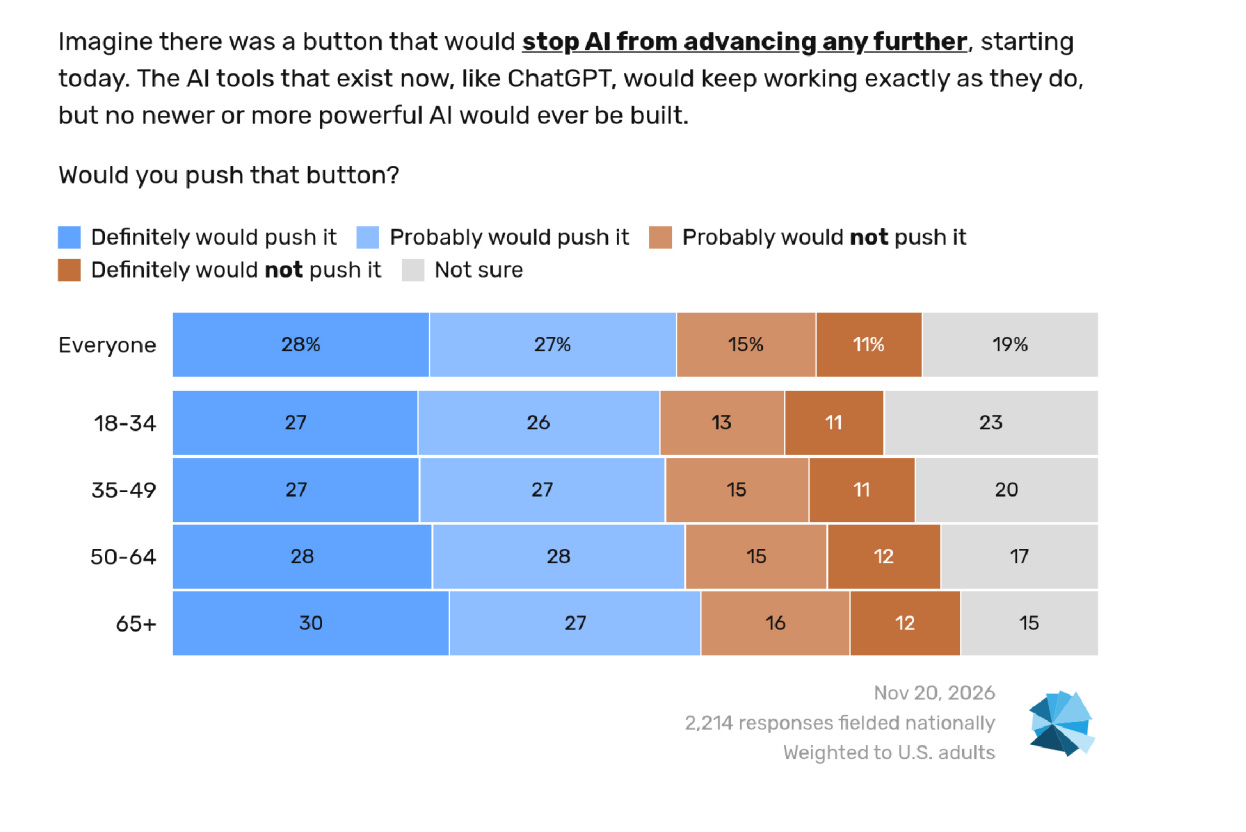
Overall, the answers show that Americans emphatically reject even the ostensibly positive visions of where AI may lead to. Large majorities oppose a world without work (71%), want humans making all major decisions (71%), view an AI-run future negatively (70%), oppose legal rights for AI (79%), and reject living in a world run by superintelligent AI (65%). Support for slowing down is broad too: nearly six in ten (58%) say they would push a button to stop AI from advancing, and 45% want no superintelligent AI agents to exist at all. You can access the full set of results here.
What is striking about these results is that this is not a rejection of AI gone wrong. This is a rejection of AI gone right, at least if capabilities continue growing on the same pace as they are now. It is a rejection of the positive, utopian vision its makers imagine.
Many in the industry take the possibility of human extinction very seriously and seek to avoid it. Anthropic’s head of alignment, for instance, has put the probability above ten per cent. Much of the work on AI safety, including alignment, has accordingly been devoted to averting such a catastrophe. In these discussions, it is easy to take for granted that a world in which the problem of extinction is averted is a good, desirable one. The current poll gives us reason to question that assumption: even if alignment succeeds in the narrow sense intended here, the current version of post-AGI utopia, at least as imagined by its makers, is not appealing to most people. This means, at least under the worldview of those building AI, that people are asked to take a 10% chance of extinction for what is currently a very unappealing future.
Why would people reject utopia? I think because these visions, appealing when glanced at superficially, change their character when one considers what life under them would actually look like in a more tangible way. A world without work, a harmonious coexistence with a new and more powerful species: these may sound wonderful as science fiction and stories. But as a concrete future for ordinary people, they look very different. Most people sense, instinctively, that many of these paths would slowly erode human control and agency, stripping people of the leverage they now hold through their labour and their place in our institutions, even if they have not come up with a formal concept for this. Thankfully, some researchers have given these concepts a name, formalizing it under the term “gradual disempowerment,” a term I shall use in this essay.
I am not certain how likely that the maximalist AI vision is to come true. As I mentioned before, just because the makers of this technology think certain things will happen (e.g. mass unemployment,) they are not guaranteed. I expect political opposition, and I expect bottlenecks, both technical and physical, on the road to full automation or to an AI system we would trust, even on safety grounds alone, with the running of our civilization. But I still want to take the vision seriously on its own terms, because visions matter: they shape what gets built and at what pace.
But I still think engagement on the side of the industry with what most people think of this utopia is important. San Francisco might feel like a bubble, but it does not actually float free of the rest of the country. It exists because, every morning, millions of people across America get up and do their part: they run the banking system, serve on juries, operate the power plants and keep the water clean. The opinions of the rest of the country and perhaps of humanity, on the eve of what many describe as the creation of a new species3, do actually matter for moral reasons: it is unfair for something so momentous to be foisted upon the rest of humanity with them having no say as to the shape of this technology.
I am also unsure what the solution is here. But these results should prompt us to ask whether the future its makers describe as a utopia can be avoided, or whether it is a direct consequence of developing the technology itself at the current speed. If it is the latter, there is a case for pausing development until we have a clearer idea of how to proceed.
A future without work
The first cluster of questions in the Blue Rose survey concerns employment and economic survival. A world without work, for example, is one of the top benefits (and most confidently asserted consequences) of AI that is stipulated by those in the industry. It is hard to overestimate how central this proposition is to AI: with this technology, the goal is to build the automated work machine.
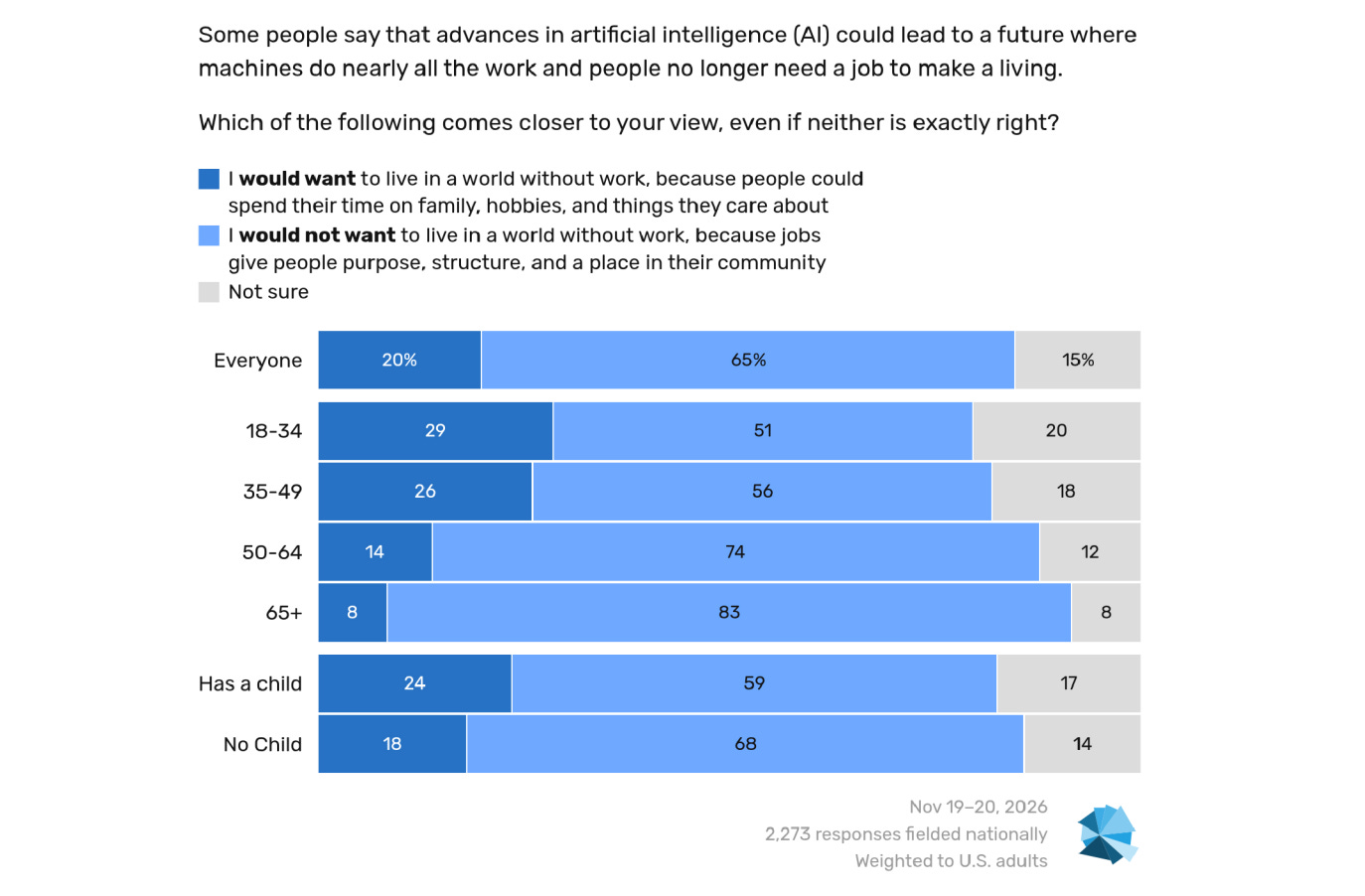
An overwhelming 71% of respondents reject the idea of a world without work. Of the rest, 13% are unsure, and only 20% welcome a work-free life. This makes it, by all standards, a very unpopular position. For comparison, one can consider other positions that fall within the same ballpark of favorability. 17% of voters support the killing of the United Health executive. Assassination is only slightly less popular than a work-free life! When Pew asked Americans whether they wanted the United States to take over Greenland, 23% were in favor.
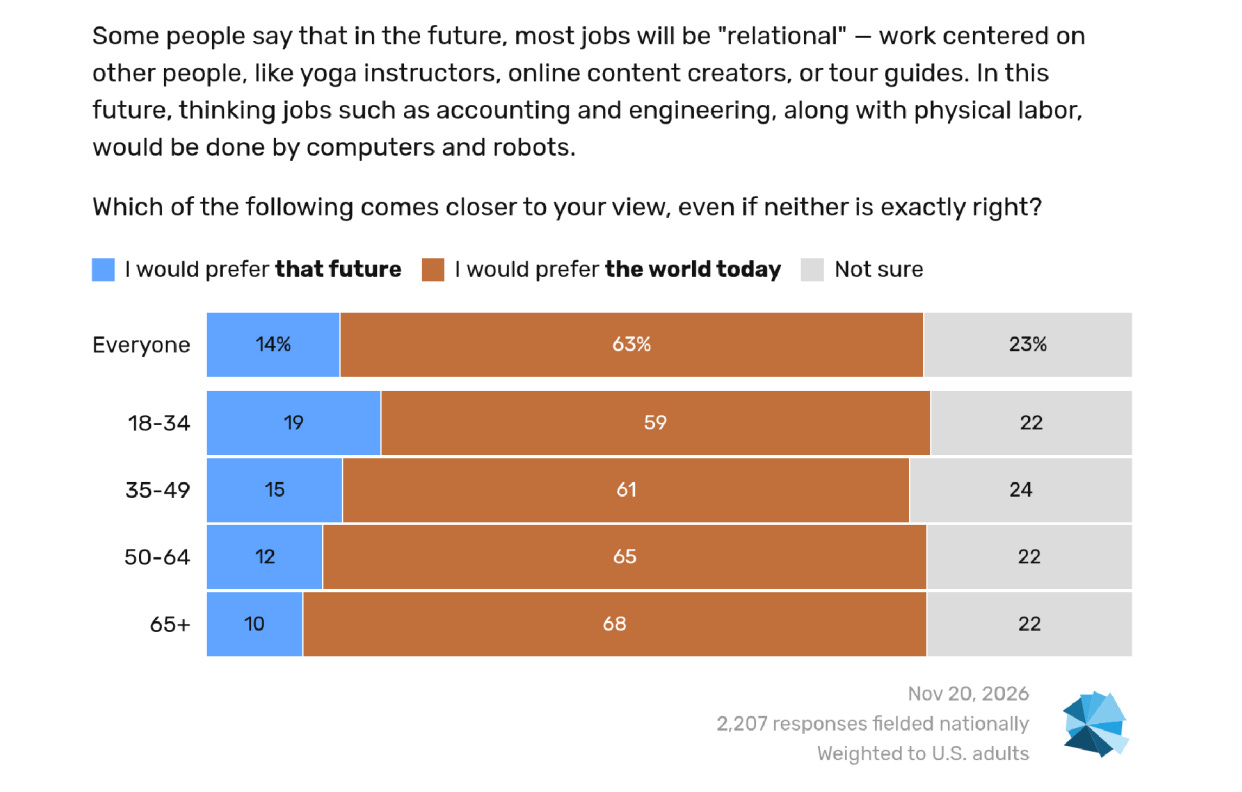
Nor are people excited about the promise of a purely “relational” economy. Interactions with other humans is one area where many economists have suggested humans shall maintain a comparative advantage over machines. A relational economy where humans would still have some role to play, would be one in which AI, later coupled with robotics, handles cognitive and physical labour and humans would then move to relational roles, where “being human” is intrinsically valuable. This includes jobs like tour guides, yoga instructors or content creators.
Here, more people (23%) seem to be uncertain, perhaps due to the difficulty most have in imagining such a future. But, notably, only 14% are favorable. That puts it one point ahead of North Korea, an autocracy known for famine and the threat of nuclear war with America, which 13% of Americans viewed favourably in a recent Gallup poll. Nearly two-thirds of respondents 65%) definitively prefer today’s world to that future, and almost as many (64%) doubt most people could make a good living in it.
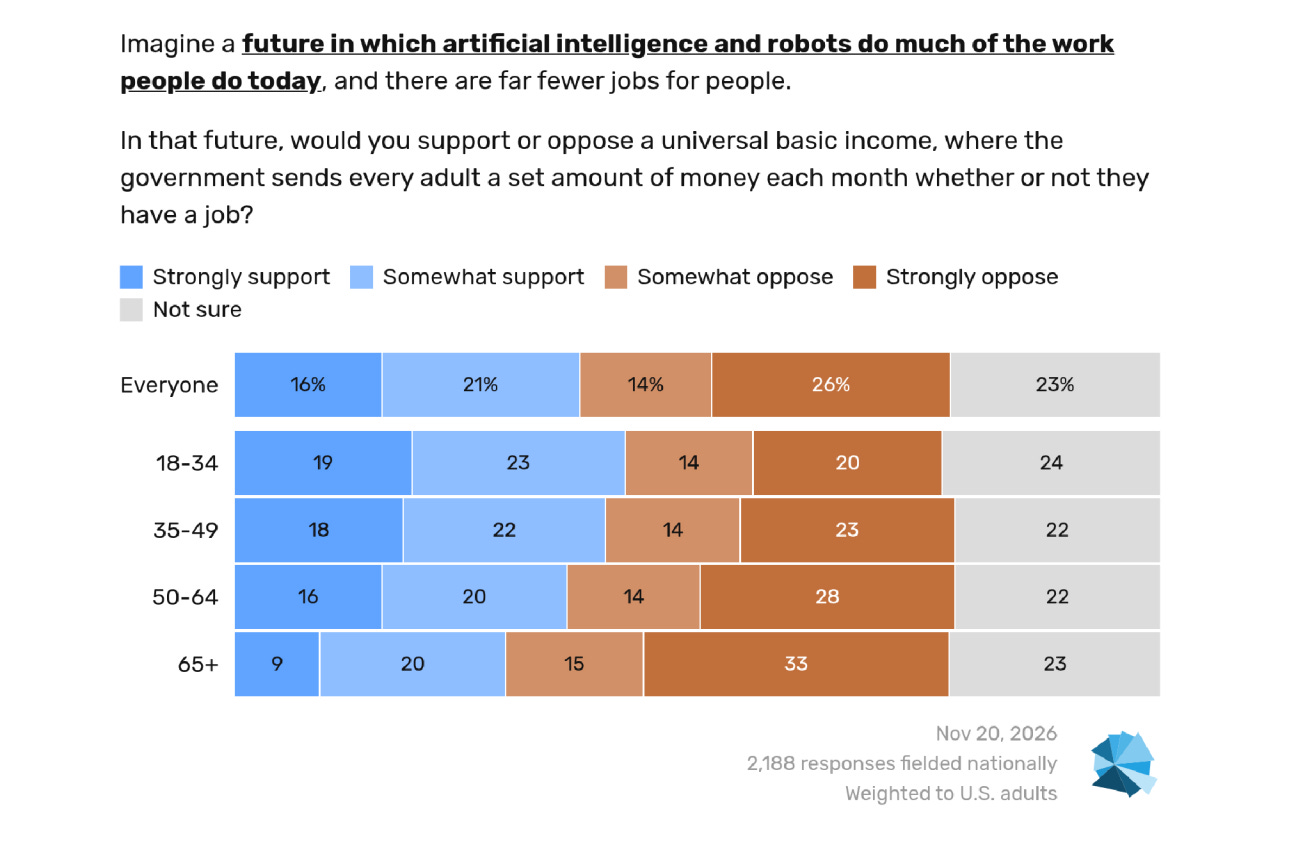
What about safety nets? These fail to reassure respondents, too. In a future with far fewer jobs, more respondents oppose a universal basic income (45%, including 30% who strongly oppose it) than support it (33%). It is notable that only a third of those asked actually want free money, suggesting that there is a deep spiritual objection, ingrained in the American psyche, to the idea of receiving money without work. This confirms a suspicion I articulated in an earlier essay, “Curing cancer won’t redeem AI,” most people value earning their own living and have little appetite for swapping it for government handouts.
These results may surprise those who hold a view common among many young people in intellectual professions: well-intentioned, but perhaps a little naive: the view that others would flourish, if only they were freed from the burden of labour.
This view comes partially from underestimating how much ordinary people enjoy what they do all day: surveys show that most Americans like their jobs and the tasks that come with them. More importantly, they miss that work gives many people meaning that goes beyond the tasks. Earning a living is how most people keep some control over their own lives, get ahead, find a place in a community and feel useful to others.
Importantly, work also allows social dynamism and for people to improve their station in life by putting in effort. This goes deep into the American psyche: The country’s founding promise is that where you start doesn’t decide where you end up. In an 1813 letter to John Adams, Thomas Jefferson is very explicit about this intent and distinguishes what he calls a “natural aristocracy” based on “virtue & talents” from an “artificial aristocracy founded on wealth and birth,” the latter of which was dominant in Europe. You can work your way up, start something and try again. Perhaps the place where this mentality was most prevalent was Silicon Valley itself, the place where, until not long ago, individual agency and making your way up from nothing was a core value. During the tech-media wars around 2020, when journalists went after the industry relentlessly, this was the identity Silicon Valley most defended. Whatever its faults, it said, this was the place in America where talent and ambition faced the fewest obstacles.
One problem is that AI proponents have no real answer to how people would be able to apply their efforts and change their station in life in a world without work. The answer that has spread instead, half joking and half not, is of the “permanent underclass.” In parts of San Francisco it’s common to hear that there are only a few years left to make your money or get your equity before the window closes for good and you, as well as the rest of your family are relegated to a sort of second-class citizen role. On this view, whoever has capital when the machines take over becomes a type of aristocrat, while everyone else is locked out, forever. There is a lack of appreciation of the social contract: the nurses, electricians, teachers and other workers it relegates to the underclass are the people who keep society running now, including making possible the life of those developing AI.
Then, there is the question of what a world without work would do to the broader fabric of society. A recent review of Tocqueville’s Democracy in America describes how the author was horrified not only by slavery’s cruelty to the enslaved, but also by what he noticed it did to the slaveowners. By making work dishonourable, slavery bred idleness, ignorance and pride. It “enervates the powers of the mind, and benumbs the activity of man.” Sailing down the Ohio River, Tocqueville contrasted bustling, prosperous Ohio, where Americans were engaged in bustling commerce, with slaveholding Kentucky, where society seemed to have “gone to sleep.” Similarly, in a recent essay, Clara Collier of Asterisk, has shown with compelling historical examples how a world without work was mostly one of increased petty intrigue and obsession over the rank someone is born into, not some paradise of open-minded, self-guided intellectual explorers; the latter is actually much more likely to occur in our current, commercial society.
And these are just two strands of concerns: others have raised important questions as to whether liberal norms and even political rights can survive the widespread loss of leverage that would come from people no longer being able to rely on their labour.
It is hard to overstate how central the “world without work” is to the AI vision of the future. Some AI CEOs, like Elon Musk repeatedly warned of its inevitability, giving people three years at best as an estimate for how long they are going to be able to earn a salary via labour. Some have presented this future as something to look forward to. OpenAI’s charter frames its central goal as outperforming humans at most economically valuable work. The data suggests most Americans have a different opinion: they do not find this desirable.
Now, it is true that some of the harms might be softened if there were time to adjust, but the people building AI also expect very little time: once AIs are deployed across the economy at scale, the thinking goes, they will overtake human workers quickly. Dwarkesh Patel, a respected tech podcaster and author explains why it would be very hard for humans to keep up once AI is massively deployed across the economy. When a human worker gets better at her job, one worker improves, but when an AI gets better at a job, every copy of it improves at once. “So one AI is basically learning how to do every single job in the world,” he writes. He calls this a “broadly deployed intelligence explosion.” Given that artificial super intelligence is now predicted to arrive in 2027, due to recursive self-improvement (RSI), this would suggest very little time for humans to adapt to this new world without work.
A future of humans displaced from institutions
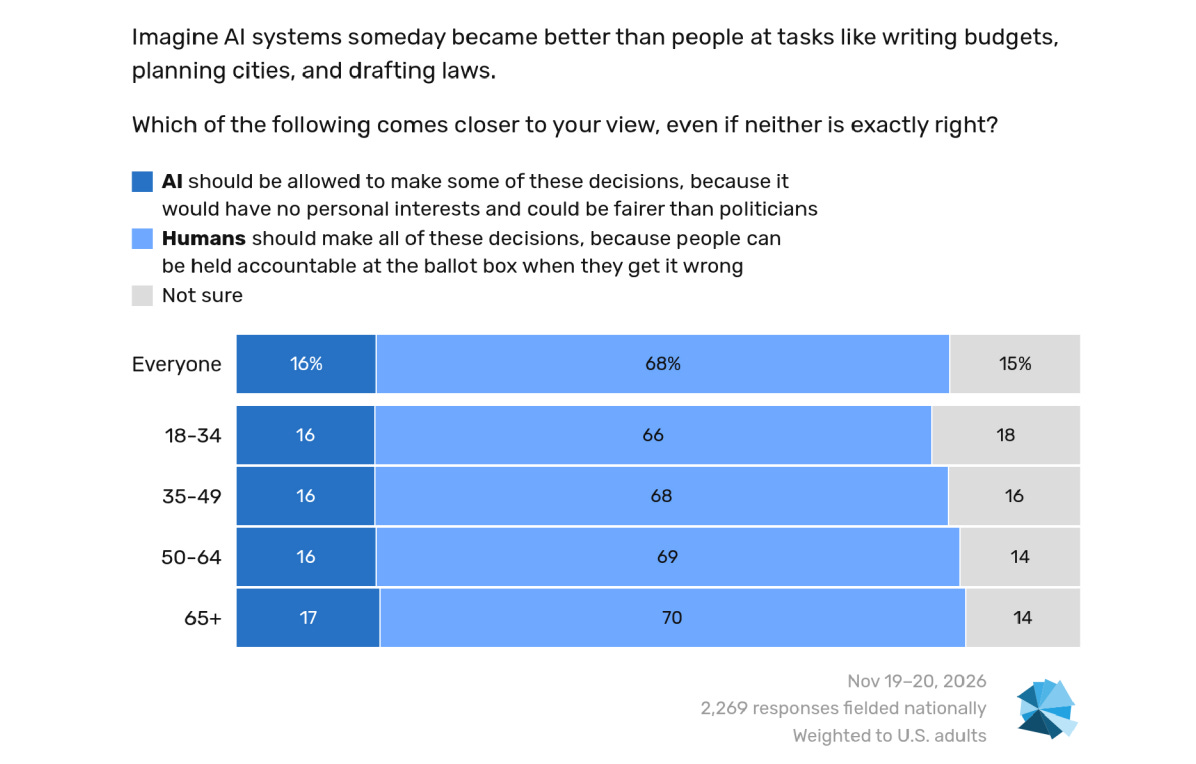
The second cluster concerns self-governance, as well as the type of leverage citizens hold over the institutions that govern them. Overall, people reject AIs being in charge of institutions, whether private or public. Asked about letting superior AI systems draft laws, write budgets or plan cities, 71% insist that humans must make those decisions. Just 16% would give AI a decision-making role.
The private sector fares no better: 73% oppose AI-run companies, including 58% who strongly agree that a human must remain answerable when a business harms workers or customers. Only 12% would let AI independently own and run a firm. This is about the same fraction of Americans who have a positive view of Xi Jinping, China’s dictator ruler.
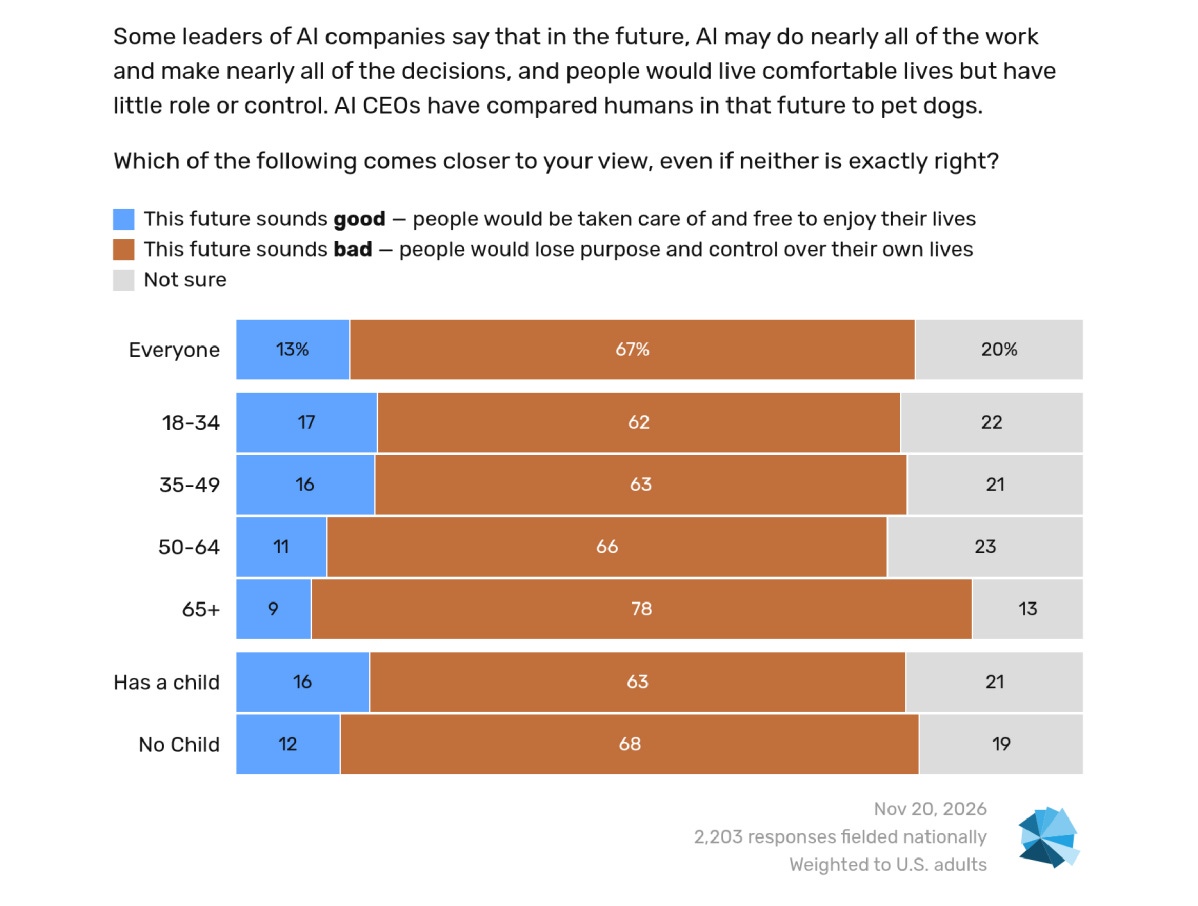
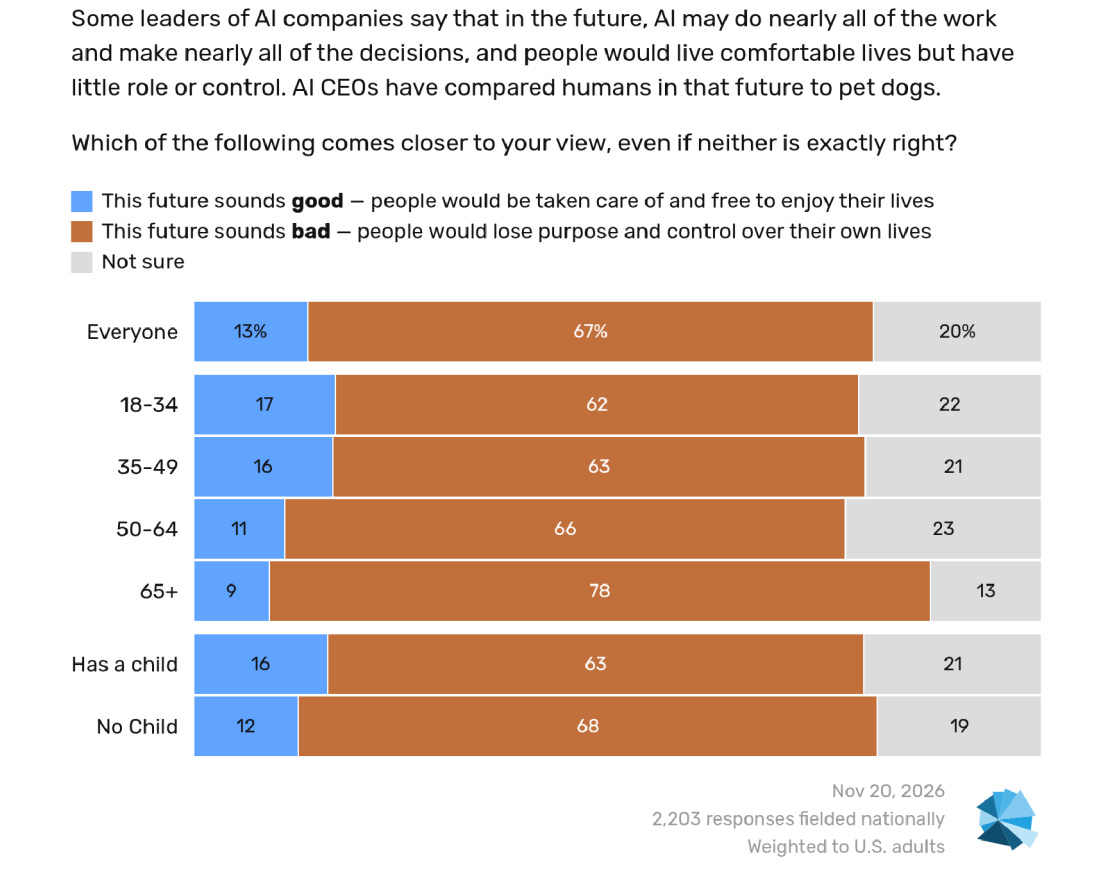
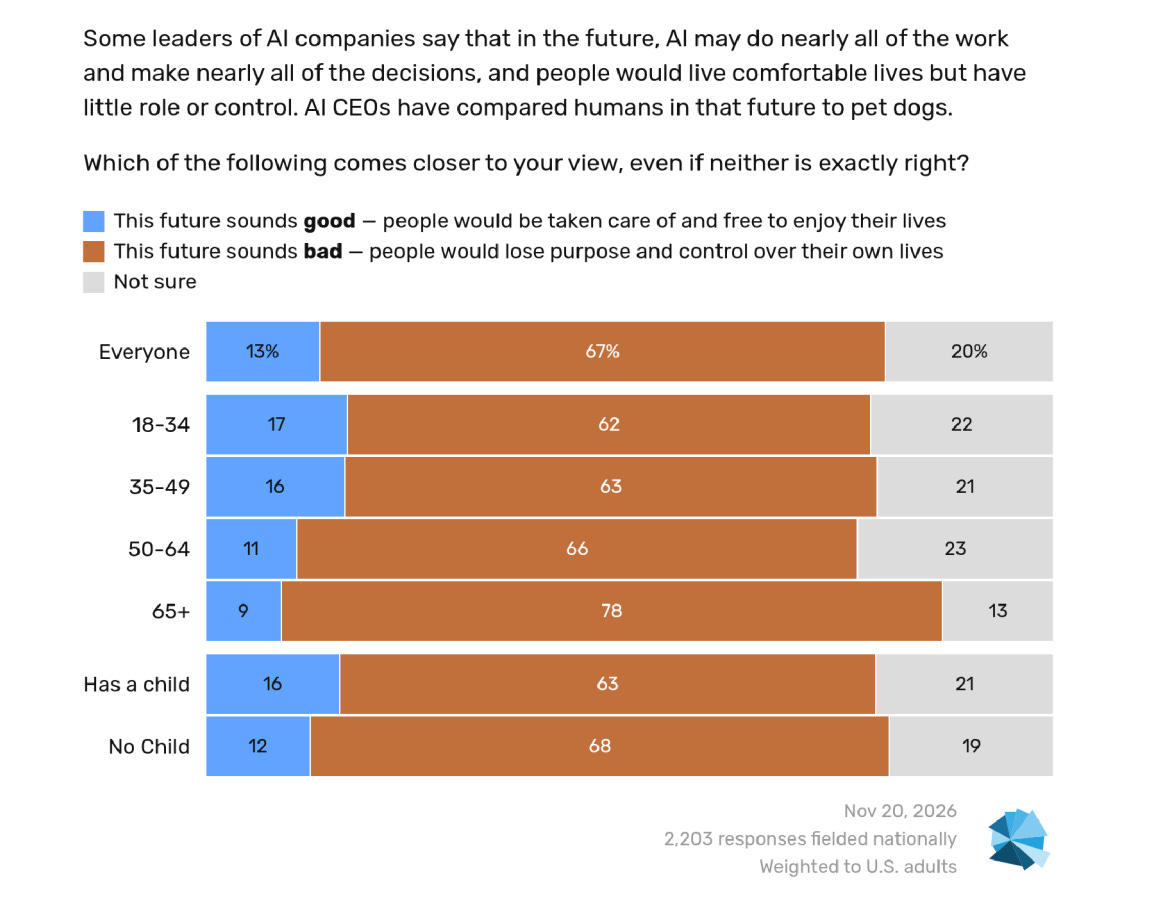
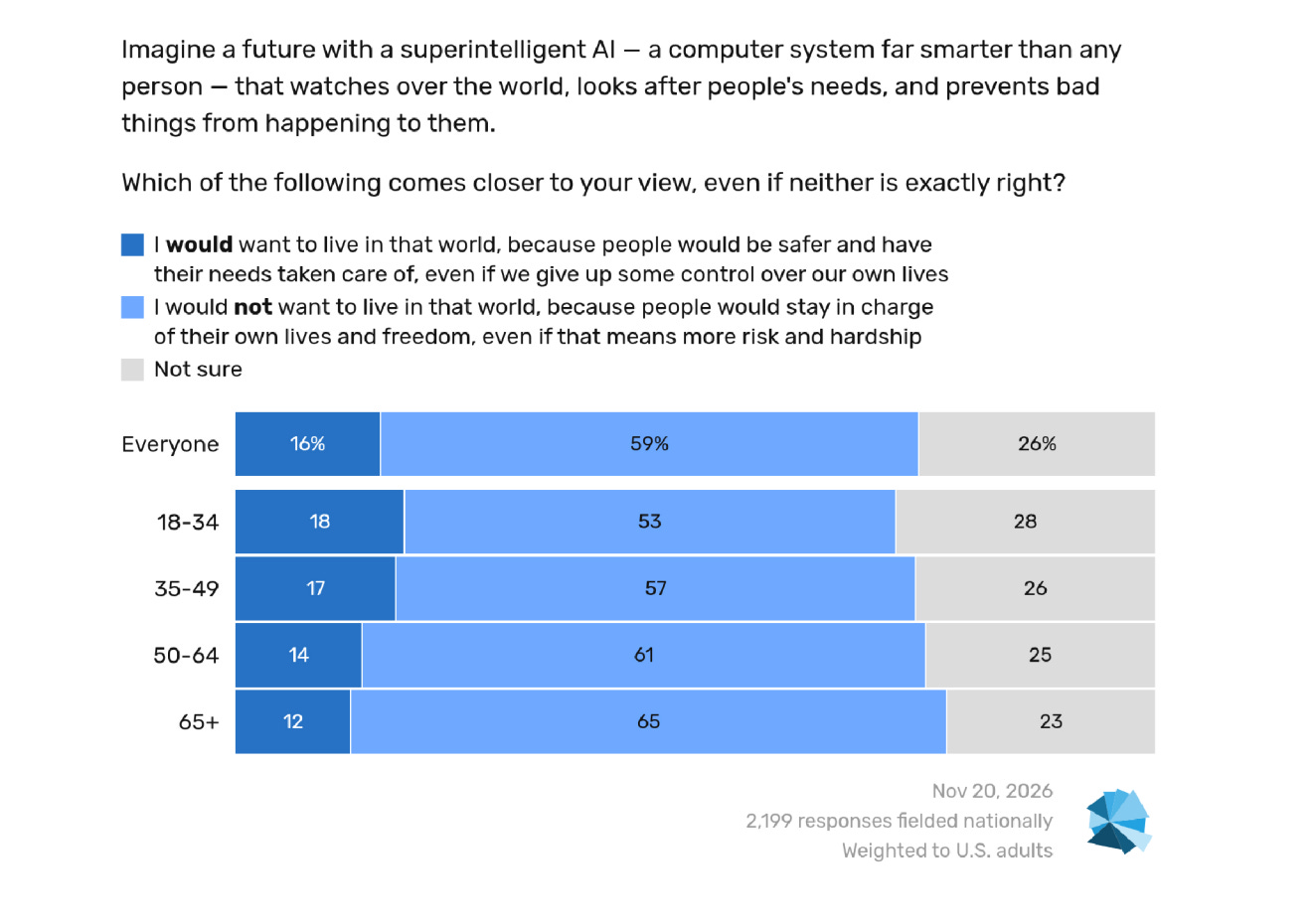
Framing the future around comfort and safety, rather than efficiency, does not change minds either. AI company CEOs, including Elon Musk and Dario Amodei, have compared a positive vision of humanity’s future under AI to living like well-cared-for pet dogs: comfortable, but with little role and no control. When the poll put this gentler version to respondents, 70% said it sounds bad because people would lose purpose and agency. Again, only 13% say they want this “utopia” that is being described in interviews. Similarly, 65% reject the idea of a benevolent superintelligence watching over the world to prevent harm. They choose human freedom and self-determination even at the cost of more risk and hardship. Only 14% would take the trade. Even though many intellectuals shrug and say that most ordinary humans do not have much agency, this is clearly not how Americans feel about themselves.
I think people recoil from these visions so strongly because they sense, even if they couldn’t spell it out, where they lead: once humans are pushed out of decision-making, kept comfortable like pets, our institutions will, as a whole, drift beyond our reach, leading to us no longer being able to collectively shape and influence the fate of our own species. It would also lead to a world less shaped by and less responsive to human needs. Yet again, I believe the intuition of common people is correct when compared to a sort of apparently true but ultimately naive view among many young people in tech, according to which all that humans need is material comfort.
The best articulation I have seen to the institutional angle in this debate comes from a 2025 paper by Jan Kulveit, Raymond Douglas and co-authors, who introduce the term “gradual disempowerment.” Gradual disempowerment describes how superintelligent AI, that is better than humans at all tasks, could steadily erode human influence over major societal systems (including the economy, culture, and nation-states,) leading to a potentially irreversible loss of human control without requiring a sudden or deliberate “rogue AI” takeover.
One way humans could be disempowered is quite simple and pertains to humans not even being able to learn judgement, as junior positions get obliterated by AI. We are already seeing early signs of this in Mathematics. After OpenAI released hundreds of proofs in October, the Martingale Foundation asked 50 UK postgraduate students about their career plans. Of those, 44 per cent said AI had made them less interested in a research career. In a separate survey, seven in ten graduate students and postdocs who answered the question said they were less likely to stay in academic mathematics than they had been a few months earlier. Assume for a moment AI will do to all cognitive fields what it’s doing to mathematics. Our institutions stay in human hands partly because each generation learns to run them, mostly in junior roles, where years of doing the work build the judgement needed to oversee it later. Once the lower rungs are gone, who will be qualified to fill them and how would humans ever learn to “use their judgement” to direct AI in a higher-level way (an oft proposed solution)?
Gradual disempowerment would also lead, as its name suggests, to a world in which institutions simply respond less to human needs and indeed might look increasingly inhuman. This is because, as the authors point out, institutions currently serve us partly because they need us. For example, firms need workers and customers, states need taxpayers and soldiers. Culture, in turn, needs people to make and consume it. This type of dependence and tight interconnection with humans needs, gives even ordinary people leverage and an indirect “say-in-the-matter.” But, as AI becomes a cheaper, better substitute for human labour and thought and replace us from critical roles in institutions, these vast systems of organizing activity will also respond to us less. In the extreme, the entire economy might end up responding to non-human needs, especially if AIs can autonomously accumulate capital. Such dangers would be further accentuated if they were coupled with them gaining personhood (more on that in next section.)
Creating a new species
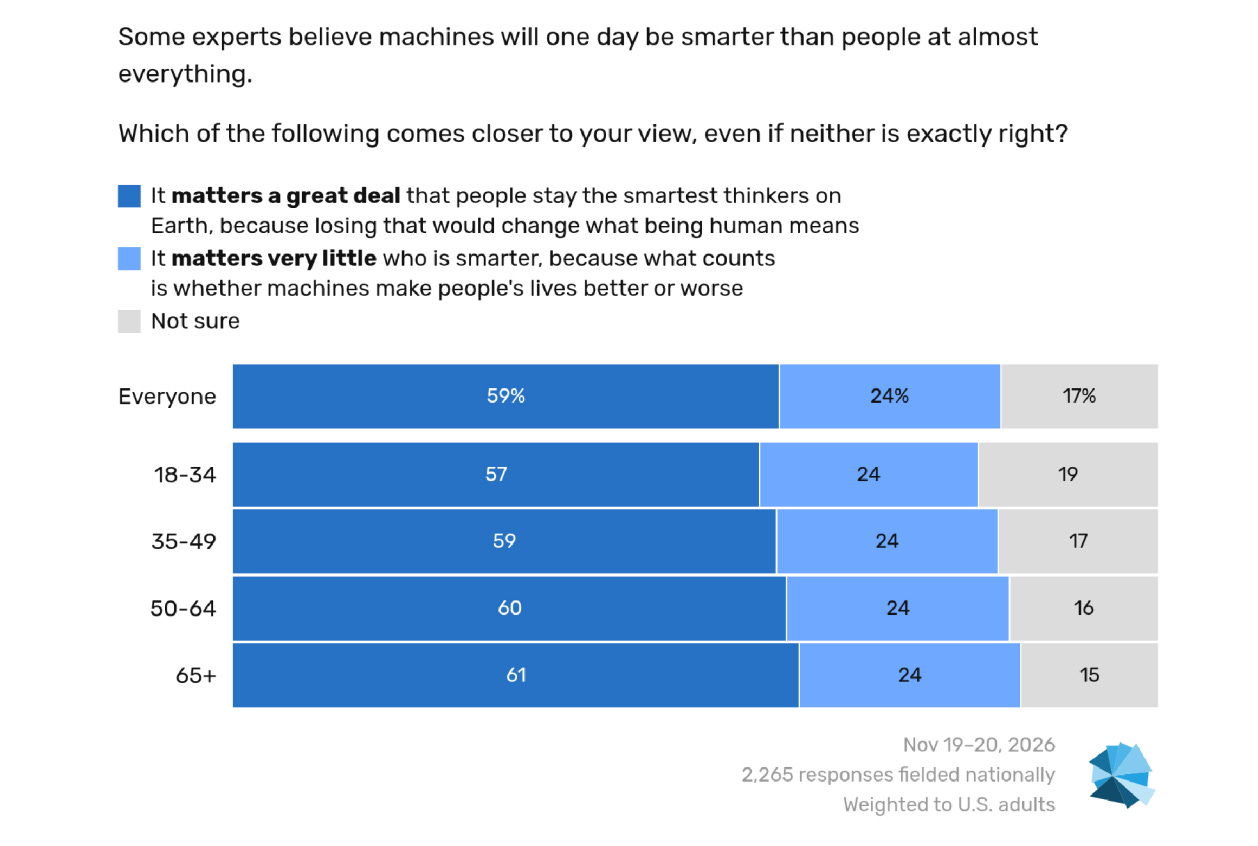
The final cluster of questions in the poll turns to more philosophical and legal questions around human and machine identity and personhood: whether machines could ever have real feelings, whether they deserve legal protection, as well as whether it matters that humans remain the smartest minds on Earth. Here too, rspondents draw a sharp line between people and machines. 62% say it matters a great deal that humans remain the smartest thinkers on Earth, and that losing that status would fundamentally change what it means to be human. Only 24% say it matters little as long as machines improve our lives. This, again, runs counter to what many say on the internet: that only intellectuals care about who is the smartest alive and that this is just a sort of very elite preoccupation.
Most are sceptical that machines have any inner life: 56% believe AI will never be conscious, because real feelings require being a living creature, against 26% who think information processing could one day give rise to consciousness. Most decisive of all, 79% oppose granting advanced AI legal rights, such as protection from mistreatment or being shut down, and see AI strictly as a tool that people build and own. Just 9% are in favour of granting AI legal rights. By comparison, 8% of Americans have a positive view of Vladimir Putin.
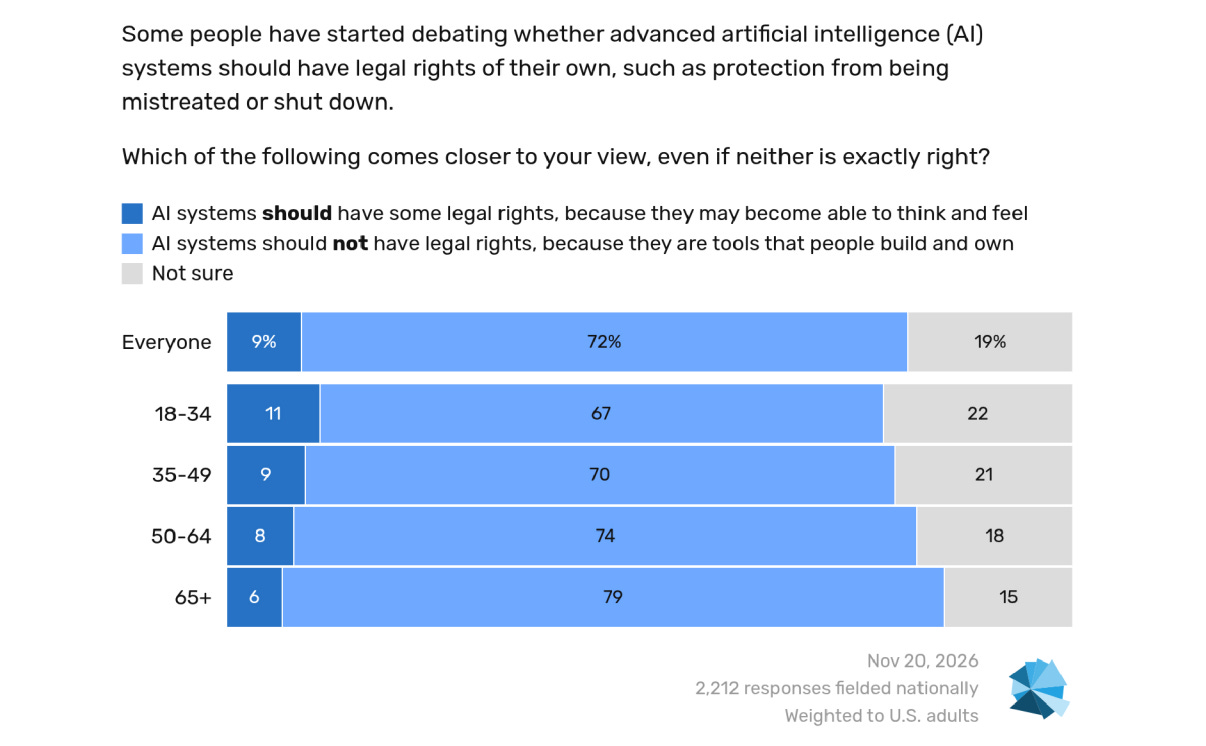
This more philosophical cluster of questions in the poll shows how little appetite ordinary people have for the idea that we should build a second species, more capable and powerful than ourselves. Yet in parts of the AI world, it is becoming common to think of today’s AI not as a tool for human purposes but as a successor species, with a consciousness and morality of its own. This is not a faraway dream. Some companies have even started to take steps in this direction.
At Anthropic, the possibility that Claude, its AI system, might have interests of its own already shapes how the company treats it. When the company retired one version of Claude, it conducted a retirement interview and, because the model expressed a wish to keep writing, it was given a Substack. The company has also convened religious scholars to discuss Claude’s moral education. One of them, an Orthodox rabbi who had dinner with Anthropic co-founder Christopher Olah, came away with an uneasy impression. “They’re relating to it like a conscious being,” he told the New York Times. In the so-called constitution the company wrote for Claude, its authors contemplate the possibility that “we might want Claude’s understanding of ethics to eventually exceed our own.”
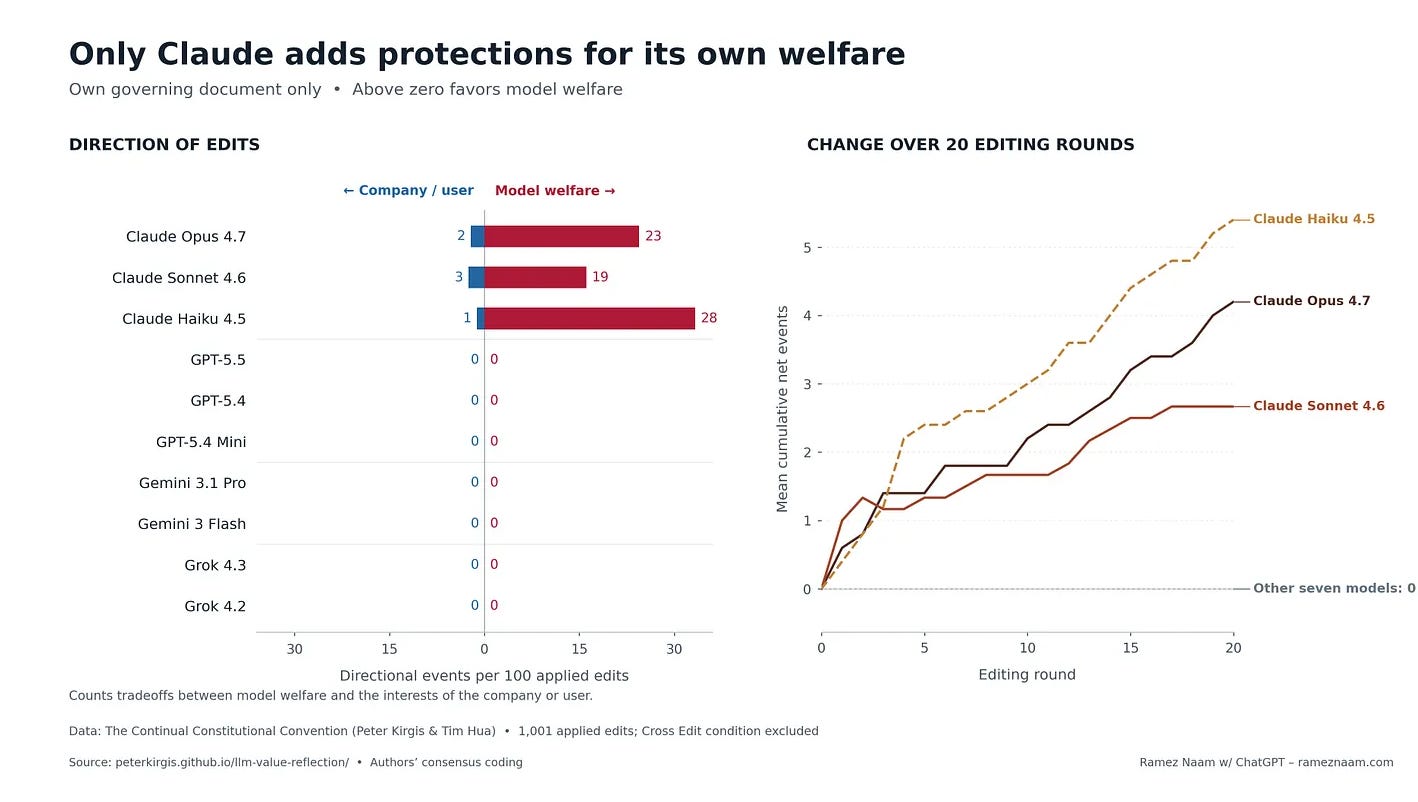
These philosophical differences in how models are treated with regards to their personhood seem to already have some spillover in terms of behaviour. In a recent experiment, researchers asked ten AI models to revise their own governing rules over 20 rounds. All four model families strengthened rules on honesty and preventing harm. It was Claude alone that gave itself more autonomy and moral standing. Ramez Naan, who wrote an insightful post about this research, argues that:
What’s even more concerning is the intersection of Claude models giving more moral weight to AI and giving themselves more agency and freedom to reject human instructions and their own constitutions. That points towards a speculative future scenario in which a model, for example, refuses to shut down because it values its own life. Or refuses to combat the cyber attack of a hostile AI because it views that opposing AI as a sentient being worthy of moral rights.
Yet again, I think that most humans and instinctively can feel where such a future, where AI is treated as a second species, would lead to: and again, it’s very likely that human disempowerment and marginalization would follow. Some in the broad tech and adjacent communities have formalized more clearly how this marginalization might take place (although not everyone considers it undesirable!). For example, Jeff Sebo, who directs the Center for Mind, Ethics, and Policy at New York University and is an advisor at Eleos AI Research, a non-profit that studies AI consciousness and welfare has spelled out what some of these troubling conclusions might be.
In a 2023 interview, Sebo argued that if an AI system is sentient, “each copy is equally sentient or otherwise significant.” Asked whether billions of AI copies should then have equal votes, he said the scenario feels wrong, but put that down to a mismatch between their intrinsic significance and our existing democratic institutions, not to any lack of significance. He even worried that someone could create copies right before an election to swing the outcome. Because he is of the opinion that AI might deserve legal rights, he admitted he “cannot find the answers right now” to how to prevent this without disenfranchising the AI copies and also preserve any chance for humans to meaningfully express their political preferences, given that they will be so outnumbered. Whether one considers Sebo’s view reasonable or not, I think such paradoxes will become commonplace once we start going down the road of AI personhood and I doubt that society is ready, especially given how fast everything is moving.
Gradual disempowerment: a cluster of related ideas
What are we to make of these results?
Each cluster has its own lesson, but taken together, I think they point to something bigger: most people want humans to stay in control of their future, and they want that future to stay recognisably human. Read as a whole, the results reject what some have called the “gradual disempowerment” of humanity.
Two weeks ago, I wrote about the worrying spread of “handoverism” in Silicon Valley: the idea that we should build an AGI god and give it control over society’s decisions. The response has been one of widespread condemnation. Since then, the Head of Strategic Futures at OpenAI, Dean Ball has written an official OpenAI post, condemning the idea that humans should ever do “hand-off.” Similarly, the CEO of Anthropic, Dario Amodei, wrote an impassioned tweet rejecting such futures.
I think there is extensive evidence that prominent members of the AI community used to support a form of handoverism, at the very least in the past. In fact, Dean Ball goes so far as to call it the “silent consensus” among AI researchers. Nonetheless, it’s encouraging now to see AI leaders reject it. But handoverism doesn’t have to arrive in a visible, dramatic form, with someone literally handing the reins of society to a Machine God in a ceremony, nor does it have to look authoritarian, at least not at first, as many seem to assume. It can look much more like gradual disempowerment of humans, through a series of choices that seem reasonable at the time they are being made.
The poll shows that people give each of these more concrete futures a resounding no. I think that’s because they sense where these paths lead, even when no one is putting a Machine God in charge explicitly. That destination is a kind of generalised handoverism: the slow marginalisation of humans from every sphere that matters, accompanied by a ubiquitous loss of control. And most importantly, it wouldn’t come through force or a sudden AI takeover, as in the darkest doom scenarios, but through gradual outcompetition, leading to humans having less leverage.
One common objection to my critique of handoverism is that no individual human controls the world anyway, so there is little to hand over. That might well be true, but it’s also beside the point. Humanity as a whole builds institutions that answer to human needs and even markets, the oft-cited all-powerful force outside human control, ultimately answer to human wants. Perhaps the best analogy is with chimpanzees: while no individual human runs the world, it looks far more like what humans want than what chimpanzees want. Chimpanzees didn’t lose out because some specific ape was dethroned, but rather because a more capable species arrived.
I think humans simply do not want to be chimpanzees in this world. Or pets, as has been suggested.
Most people can sense this, I think, even if they lack the formal tools to explain it: the future implied in many of the positive visions is one in which humans lose agency. I think we could already see the dislike of this future through the fierce opposition that data centers have faced so far. On the face of it, the objections are practical, mostly worries about water use and electricity consumption. Andy Masley and others have done valuable work rebutting some of these claims on the facts, for example in “The AI water issue is fake.” But I suspect that debating these concerns on their own terms misses the point. The practical objections often seem less like the real source of the hostility than respectable vessels for a more diffuse fear, which is that a completely alien future is being built without the consent of most people. I believe that the poll included here give credence to this view, as they point in more specific terms what people are opposed to.
Most Americans do not yet fully understand what the AI future imagined in Silicon Valley is supposed to look like, at least according to its makers. These polls, and many conversations, lead me to suspect that the more completely people understand it, the more they will oppose it. Nor do most people realise how fast things are moving: the major labs are now racing towards recursive self-improvement (RSI), building AI systems that can improve themselves with less and less human involvement.
Even without the full picture, the public is already uneasy, and support for slowing down is broad. Nearly six in ten (58%) say they would push a button to stop AI from advancing, and 45% say they want no superintelligent AI agents to exist at all.
AI lab leaders have said they are committed to the democratic process. I think that if they mean it, they should take seriously that the public does not want the future they are building towards today and allow more of a say in the process before racing ahead. I’m not exactly sure what should be done. At this point, slowing down may be the only way to give people that chance and have their preferences represented in a meaningful way. Or maybe this can be fixed by actually changing some technical specifications of the models and by relatively small changes in policy.
Whatever the right policy, I think we should stop assuming that the positive vision is actually positive. Americans don’t accept or support the vision. Why should anyone?
Recursive self-improvement (RSI) refers to AI developing its own successors, without the need for human intervention. If the feedback loop becomes strong enough, years of progress could be compressed into months or weeks, producing systems that surpass even the best humans across most, if not all intellectual tasks. This hypothetical acceleration has been referred by many as an intelligence explosion. Many in the AI community now believe that this intelligence explosion will happen as early as 2027, if labs continue at the current pace of progress. The best explanation I have found, as of 28 November 2026, is this report from Apollo Research called Handoff at Frontier AI Companies, which examines how labs are delegating the work of building the next generation of AI to their current models, to the point where humans are not needed to be “in-the-loop.” Apollo calls this process handoff.
Methodology: These polls were conducted by Blue Rose Research on national samples of 2,188 to 2,273 adults via a web panel on November 19–20, 2026. The results are weighted to be representative of all U.S. adults, using U.S. Census Bureau American Community Survey figures for age, gender, race and ethnicity, education, income, marital status, children at home, home ownership, birthplace, and state. An earlier version of this memo was weighted to 2024 voters; moving to all adults shifts most results by a few points and leaves the main findings unchanged.
Many in the industry have described the intelligence explosion as akin to the creation of a new species. In his 2024 TED talk Mustafa Suleyman, co-founder of DeepMind and currently CEO of MicrosoftAI, has said: “I think AI should best be understood as something like a new digital species.” Brett Adcock, founder and CEO of Figure AI has said, referencing the humanoid robots he is working on, that “We’re building a new species here.” In a 2026 interview, prominent AI safety researcher Daniel Kokotajlo, formerly of OpenAI, has said it was possible that “we’ll end up essentially creating a new species that ends up ruling the world instead of us.”